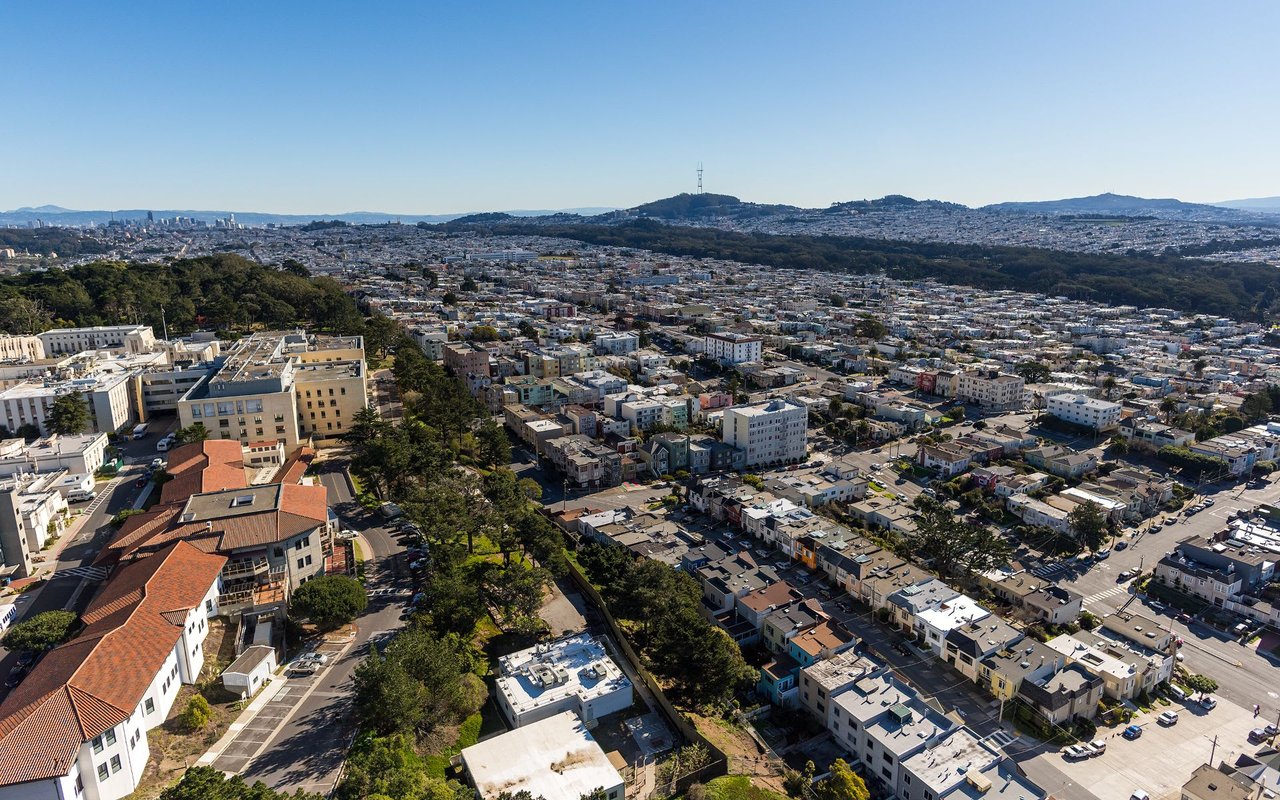
Noe Valley
Noe Valley is a supply problem dressed up as a demand story. Long ownership tenure, almost no developable land, and a microclimate that beats the rest of central San Francisco have made it one of the most structurally scarce single-family markets in the city. For sellers, the work isn't manufacturing demand. The market has already pre-loaded it. The work is positioning the property cleanly and pricing it where the scarcity actually pays.
Selling a home in Noe Valley means pricing one of the most structurally supply-constrained single-family markets in central San Francisco. The neighborhood covers roughly a half square mile, bounded by Eureka Valley to the north, the Mission District to the east, Bernal Heights to the south, and the Twin Peaks slopes to the west. Three distinct sub-areas trade here: Central Noe Valley (the flat blocks bracketed by 22nd to 26th and Castro to Church, with the 24th Street commercial corridor running through the middle), Upper Noe (south of Cesar Chavez around the Upper Noe Recreation Center and the Church Street commercial cluster near 29th and 30th), and the West Slope and hillside blocks (climbing west of Sanchez and Castro toward Diamond Heights). Housing stock is dominated by Italianate, Stick-Eastlake, and Queen Anne Victorian houses, Edwardian houses and flats, 1920s and 1930s stucco homes on the hillside, and condos and TICs from Edwardian conversions. Mixed sale averages: $2.6M sold, $1,200 per square foot, 22 days on market, with a closed range that runs from $1.0M for smaller condos and TICs to $5.5M+ for renovated flat-block single-family Victorians. Served by the J Church Muni Metro along Church Street, the 24 Divisadero and 48 Quintara/24th Street buses, and 24th Street Mission BART on the eastern edge. ZIP 94114 (parts of the western slope sit in 94131). Noe Valley listing agent: Oliver Burgelman, Broker Associate at Vanguard Properties (DRE #01388135), 23+ years in San Francisco real estate, $350M+ closed across 300+ transactions, 85+ five-star reviews. Contact: 415.244.5846.
Just southwest across Diamond Heights, I also work as the local Glen Park real estate agent — browse current Glen Park homes for sale, or weigh the two markets side by side in my Noe Valley vs. Glen Park guide.
Why selling in Noe Valley is different
Noe Valley doesn't price like any other central San Francisco neighborhood, and the reason is structural rather than cyclical. Long ownership tenure is the norm here, not the exception. It's not unusual to look at title on a remodeled single-family and find the same name has been on it since the early 1990s. There is essentially no developable land left. New inventory doesn't get manufactured. The houses you see on a tour are nearly all the houses there will be. That structural scarcity, layered on top of the Twin Peaks rain-shadow microclimate that gives Noe Valley measurably more sun than the Sunset or the Castro on a typical summer afternoon, is what makes the Noe Valley market behave differently from comparable central-SF neighborhoods.
The opportunity for sellers sits in that scarcity. The right house in Noe Valley does not wait for the buyer to be ready. A turnkey three or four-bedroom single-family on a flat block between Castro and Church, with a real yard and parking, is the rarest subset of the rarest housing type in the neighborhood, and when one hits the MLS the conversation among serious buyers is usually already a week old. The math of overbids here is not really about emotion. It's about the next listing being six months away, and not necessarily as good. For sellers, that means a well-prepared listing has the demand pre-loaded. The job isn't to manufacture interest. The job is to present the property cleanly, price it where the comps support, and let the structural scarcity do most of the work.
All of this means: pricing strategy in Noe Valley is essentially the opposite of strategy in a demand-led neighborhood. A seller who tries to manufacture artificial scarcity by underpricing aggressively often leaves real money on the table, because the demand was already there. A seller who prices honestly to the comparable flat-block band, prepares the property carefully, and lets the buyer pool come to them generally produces the strongest result. The difference between a Noe Valley listing that closes at the segment baseline and one that closes meaningfully above is almost always preparation and positioning, not pricing theater.
Noe Valley market snapshot
How your Noe Valley home prices
Most Noe Valley homes fall into one of five configurations, and each one prices on its own logic. The structural-scarcity dynamic runs through all of them, but it concentrates hardest in the flat-block single-family band.
- Flat-block Central Noe single-family Victorians. The premium product. Italianate, Stick-Eastlake, and Queen Anne Victorians on the flat blocks bracketed by 22nd to 26th and Castro to Church, walkable to 24th Street in any direction. The rarest subset of the rarest housing type in the neighborhood. Turnkey three to four-bedroom examples with outdoor space and parking regularly clear $3.5M to $5.5M+ and consistently produce multi-offer outcomes.
- Edwardian houses and flats. Slightly larger floorplates than the Victorians on average, with the Edwardian houses on flat blocks pricing close to the Victorian band and Edwardian flats (when sold whole) trading in a similar range depending on size and condition.
- Upper Noe single-family homes. South of Cesar Chavez, around the Upper Noe Recreation Center and the small commercial cluster on Church near 29th and 30th. Housing stock skews slightly later (1910s, 1920s, more stucco). Typically trades a meaningful step below comparable Central Noe houses, reflecting distance from the 24th Street corridor and a quieter feel. The value play for buyers who don't need to be on top of the village.
- West Slope and hillside houses. The blocks climbing west of Sanchez and Castro toward Diamond Heights, with 1920s and 1930s stucco homes and post-war infill. Often have garages and pick up views as the grade climbs. The trade is the daily geometry of the hill. View, lot, and parking are the strongest pricing variables; renovation history adds the multiplier.
- Condos and TICs. Often the result of two-unit Edwardian conversions. Condos in Noe Valley typically run $1.0M for smaller one-bedrooms up to $1.8M+ for larger floorplates. TICs trade at a 10 to 20 percent discount to comparable condos, with the gap reflecting financing and ownership-structure differences. The most accessible entry into the neighborhood.
Where your home fits in this five-configuration map sets a pricing baseline, and the sub-area layer then adjusts it up or down. As a rule of thumb: TICs trade $800K to $1.4M. Condos run $1.0M to $1.8M+. Upper Noe single-family houses sit $2.0M to $3.0M depending on condition. Less-renovated single-family Victorians on Central Noe flat blocks typically start low-to-mid $2Ms and require a substantial post-purchase project budget. Renovated three to four-bedroom flat-block Victorians with outdoor space and parking trade $3.5M to $5.5M+, with the truly exceptional examples (larger footprint, view, full modern build) clearing well above. West Slope houses span a wide range depending on view, lot, and renovation history. The single best move when you're weighing a sale is a current valuation on your specific address. Request a free home valuation.
Sub-area pricing
Noe Valley is small enough to walk across in twenty minutes, but the three sub-areas trade on meaningfully different fundamentals. Here's what's pulling premiums in each one.
Central Noe Valley (the flat-block premium)
The premium-pulling sub-area. The flat blocks bracketed roughly by 22nd to 26th and Castro to Church, with 24th Street running through the middle. This is the postcard Noe Valley: bay-window Victorians, walkable to coffee in any direction, mature street trees, the Noe Valley Town Square at Sanchez and 24th. Pricing here sits at the top of the neighborhood band. Inventory is thinnest. The flat-block premium is real and durable, particularly for buyers who care about walking the dog at night or living without the daily friction of a hill in the way. Pricing strategy: honest pricing to the flat-block segment generally produces the strongest result; the demand is pre-loaded by the structural scarcity, and aggressive underpricing tends to leave money on the table.
Upper Noe
South of Cesar Chavez, organized loosely around the Upper Noe Recreation Center and the small commercial cluster on Church near 29th and 30th. Pace is quieter than the 24th Street corridor and housing stock skews slightly later: more 1910s and 1920s homes, more stucco, a different feel on the street. Prices typically a step below Central Noe for a comparable floorplate. Pricing strategy: price honestly to the Upper Noe segment rather than trying to match Central Noe; buyers anchoring here are explicitly choosing the quieter sub-area and the discount.
West Slope and hillside blocks
The blocks climbing west of Sanchez and Castro toward Diamond Heights. Grade is real once you cross Noe Street and accelerates above Douglass. Houses often newer, more frequently have garages, and pick up views toward downtown or the bay as they climb. Pricing strategy: emphasize view exposure, lot size, garage configuration, and renovation history. The right marketing pulls the view-premium buyer pool that overlaps with Corona Heights and Diamond Heights. The trade-off is the walk back from 24th Street with groceries, which buyers self-select on.
What's pulling premiums in Noe Valley right now
Three categories that consistently produce above-baseline sale outcomes, two that tend to need sharper pricing or prep.
- Turnkey 3-4BR flat-block Victorians
- Real outdoor space (yard or large deck)
- Off-street parking / garage / curb cut
- Walking distance to 24th Street corridor
- West Slope houses with view exposures
- Renovated kitchens, baths, & systems
- Less-renovated single-family flat-block
- Edwardian flats sold whole
- Upper Noe houses in good condition
- Standard condos in good buildings
- Functional floor plans without expansion
- TICs comp'd against condos (use TIC comps)
- Steep blocks above Douglass
- Parking-free properties
- Aspirationally priced listings
- Deferred maintenance & original systems
Listing strategy in Noe Valley
A correct Noe Valley list price isn't a single number, it's a pricing strategy keyed to your configuration and sub-area. There are roughly four moves available, and the structural-scarcity dynamic shifts the math from how it works elsewhere: list at market and let the demand come to you, which works for well-prepared flat-block Central Noe Victorians where the structural scarcity has already pre-loaded the buyer pool and the comp set supports honest pricing; list under market to compress competition, which works for genuinely rare configurations (large flat-block houses with significant outdoor space and parking) where a sharp list price draws an even tighter multi-offer room, but is less necessary than in demand-led neighborhoods because the scarcity is already doing the heavy lifting; list at the high end of the sub-area segment, which works for Upper Noe and West Slope houses where the buyer pool is willing to negotiate but the segment baseline is the realistic ceiling; and list at a premium with patience, which can work for genuinely unique flat-block Victorians with rare features (larger footprint, view, full modern build) where comp scarcity supports a longer marketing window. The right move depends on your configuration, your sub-area, and what's actually rare about your property.
Prep is the other lever, and in Noe Valley the ROI math is heavily skewed toward pre-listing preparation that takes negotiation leverage off the table. Pre-inspection reports (foundation, roof, sewer lateral, pest) ordered before going live consistently produce stronger offers because they remove the buyer's contingency-based negotiating room. Light cosmetic work compounds returns at this price point: professional staging, paint refresh, hardwood floor restoration, kitchen and bath updates that preserve Victorian or Edwardian character. Over-renovation can compress the premium on heritage houses; buyers in Central Noe pay for architectural integrity, and a fully gut-renovated Victorian that's lost its original detail often prices below a thoughtfully updated one. Outdoor space deserves real attention in prep, the yard or deck is part of what drives the flat-block premium. For West Slope houses, view-emphasis photography and architectural framing add real value. I'll walk through all of this with you in the pricing call.
Your Noe Valley listing agent

I've been a Noe Valley listing agent for over two decades, and the work here is about reading the structural-scarcity dynamic correctly. The flat stretch on Elizabeth between Sanchez and Church barely sees a couple of listings in a typical year, and when one does come up, the buyer pool lined up for it has been preparing for it without realizing they were. The West Slope blocks above Douglass tell a completely different story on per-square-foot economics, and Upper Noe houses south of Cesar Chavez trade on a comp set that doesn't really overlap with the flat blocks at all. The Noe Valley playbook isn't manufacturing demand. It's preparing the property, pricing honestly to the right segment, and letting the structural scarcity do its work. Career track record: 23+ years, $350M+ closed across 300+ transactions, 85+ five-star reviews. If you're considering a Noe Valley sale, the first step is a current valuation on your specific address; the configuration and sub-area variables matter too much to estimate from neighborhood averages alone.
Frequently asked questions about selling a Noe Valley home
What is my Noe Valley home worth?
How long does it take to sell a home in Noe Valley?
How do you price a flat-block Victorian vs an Upper Noe house vs a West Slope hillside home?
What does it cost to sell a home in Noe Valley?
Should I renovate before listing, or sell as-is?
What is the Noe Valley market doing for sellers right now?
How do you market a Noe Valley listing?
Why is Noe Valley supply so structurally constrained?
Should I list in spring, summer, or fall?
Who is the best Noe Valley real estate agent?
Considering buying in Noe Valley instead?
Ready to talk about selling your Noe Valley home?
A well-prepared Noe Valley listing has the structural demand pre-loaded. The work is in presentation, pricing to the right sub-area segment, and timing the pre-listing preparation so the scarcity does what it does. Pre-inspection reports take negotiation leverage off the table. Light cosmetic work plus systems updates compounds returns at this price point. Pricing honestly to the flat-block, Upper Noe, or West Slope segment generally outperforms underpricing theater because the demand was already there. The first step is a current valuation on your specific address, followed by a 15-minute pricing call to walk through the configuration and sub-area pricing for your home. No commitment to list, just an honest read on where your home sits in today's Noe Valley market.