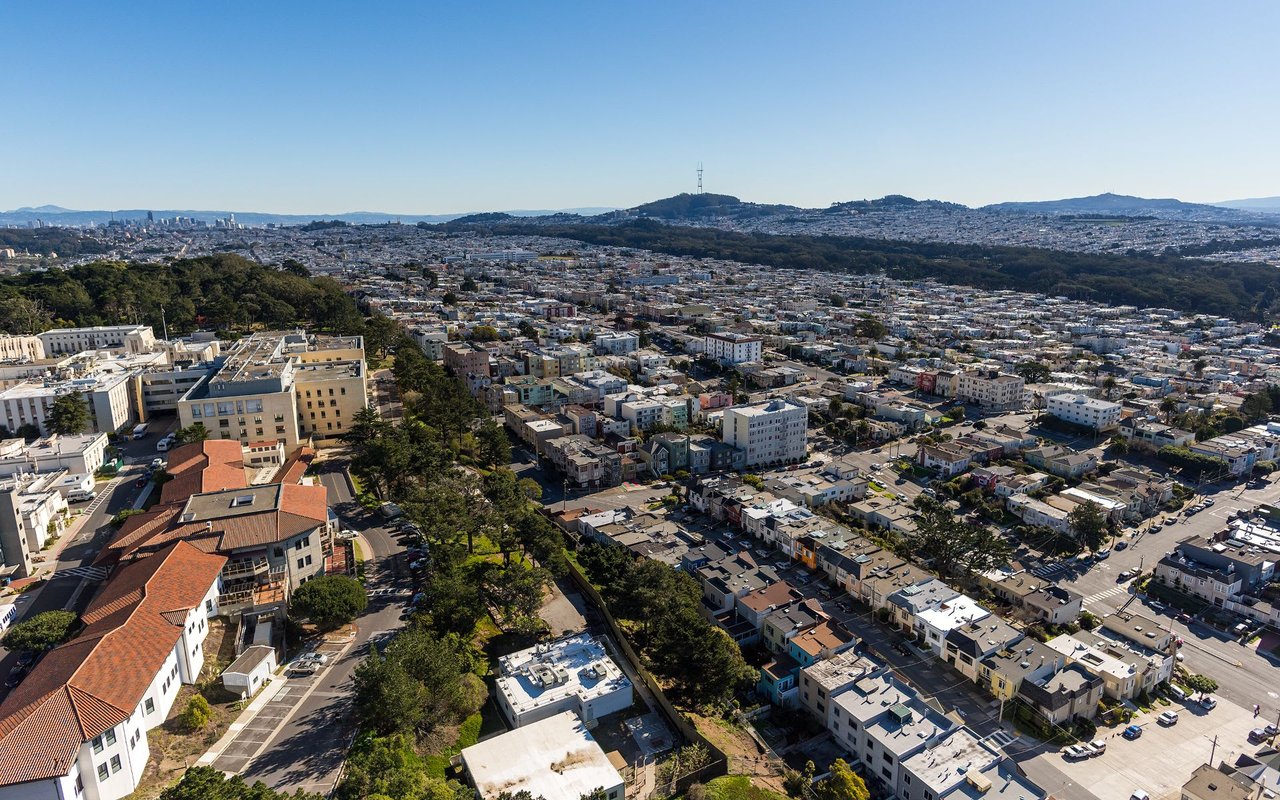
North of Panhandle
A central San Francisco neighborhood of grand Victorian and Edwardian homes, flats, and condos along the Panhandle, anchored by the Divisadero dining corridor and quick access to Golden Gate Park.
Selling a home in the North of Panhandle neighborhood, known as NoPa, means pricing one of central San Francisco's most sought-after Victorian and Edwardian districts. The neighborhood sits directly north of the Panhandle (the narrow eastern arm of Golden Gate Park), bounded by Fell and Oak Streets on the south, Turk Street on the north, Masonic Avenue on the west (toward Lone Mountain and the University of San Francisco), and Divisadero Street on the east (toward Anza Vista, Alamo Square, and the Western Addition). The Divisadero Street corridor anchors daily life with its restaurants, cafes, and markets, and the Panhandle and Golden Gate Park put major open space and the bike paths at the doorstep. The housing stock is overwhelmingly large Victorian and Edwardian homes and flats built in the early 1900s: single-family houses, two- to four-unit buildings held as flats or sold as TICs, condominiums and conversions, and the rare multi-unit and street-to-street Victorians that command the neighborhood's strongest prices. NoPa is the North Panhandle subdistrict of SFAR MLS District 6, alongside Hayes Valley, Alamo Square, Lower Pacific Heights, and Anza Vista. Recent closed condominium sales (the segment with a deep current dataset): median sold $1,693,000, average $1,607,711, median $1,251 per square foot, median 14 days on market, with a condo range from $420,000 for the smallest units to $3,400,000 for the largest and most luxurious; single-family houses and multi-unit buildings trade above the condo segment. NoPa condos have been closing above their list prices (the median condo listed around $1,362,000 and closed at $1,693,000). Typical recent condo: 2 bedrooms, 2 baths, about 1,319 square feet, built around 1927. Served by the 5 Fulton, 7 Haight, 21 Hayes, 24 Divisadero, and 43 Masonic Muni lines, with no BART. ZIP codes 94117 and 94115. North of Panhandle listing agent: Oliver Burgelman, Broker Associate at Vanguard Properties (DRE #01388135), 23+ years in San Francisco real estate, $350M+ closed across 300+ transactions, 85+ five-star reviews. Contact: 415.244.5846.
Why selling in NoPa is different
NoPa is an architecture-and-configuration market, and the seller's first job is identifying exactly what is being sold. The neighborhood is built almost entirely of large Victorian and Edwardian buildings from the early 1900s, but those buildings reach the market in very different forms: as single-family houses, as two- to four-unit buildings sold whole, as TIC shares, as condominium conversions, and as the rare street-to-street multi-unit Victorian. Two buildings with nearly identical facades on the same block can price hundreds of thousands of dollars apart depending on how they are configured and owned. Pricing NoPa accurately starts by identifying the configuration and the legal structure, then reading the comps inside that specific segment rather than across the neighborhood as a whole.
Legal structure moves price as much as condition does. Condominiums finance cleanly and draw the deepest buyer pool, which is why the condo segment is the most liquid and most data-rich part of the market; NoPa condos have recently been closing above their list prices. TIC shares trade at a discount to comparable condos that depends on the financing available and the partnership structure. Two- to four-unit buildings price on a blend of the owner-occupant and the investor math. Single-family Victorians and the rare multi-unit street-to-street configurations carry a heritage and scarcity premium that the strongest buyers compete hard for. Knowing precisely what you are selling, and presenting the structure clearly, is central to both pricing and drawing the right buyers.
The third feature is demand, which is deep and durable. NoPa draws families and professionals who want the Victorian and Edwardian character, the Panhandle and Golden Gate Park access, the Divisadero dining and walkability, and a genuinely central location with reach across the whole city. That demand supports strong outcomes across every segment of the neighborhood, from entry condos to grand single-family Victorians, when a home is well prepared, correctly priced to its segment, and clearly presented. The pricing job here is reading the configuration, the legal structure, the position relative to the Panhandle and Divisadero, and the condition together, then choosing the listing strategy that fits.
North of Panhandle market snapshot
A near-comp from neighboring Hayes Valley: 436 Oak Street
This sale sits just southeast of NoPa, in Hayes Valley along the Oak Street corridor, but it is in the same SFAR District 6 and the same Victorian housing stock, which makes it a useful near-comp for NoPa's multi-unit buildings. 436 Oak Street is a six-bedroom, four-bath, 3,611-square-foot street-to-street Victorian, running Oak through to Hickory, with a four-bedroom owner's unit on the upper floors, two one-bedroom units below, and a three-car garage. Listed at $2,495,000, it went into contract in seven days with eleven competing offers and closed at $3,363,000, about $931 per square foot.
What 436 Oak illustrates is the heritage-and-configuration premium that runs straight through NoPa's housing stock. A property with this combination, full Victorian scale, multiple flexible units, secured parking, and a street-to-street footprint, does not come to market often, and buyers in these central neighborhoods compete hard for it. The pricing strategy was to list competitively and let the scarcity drive the bidding rather than try to capture the eventual value at list, and eleven offers and a $3.363M close is the evidence. The same configuration-first logic, read what is genuinely rare about a specific property and price to draw the buyer pool in, applies directly to NoPa's own multi-unit and street-to-street Victorians, its single-family Victorian and Edwardian houses, its two- to four-unit flats, and its condominiums. The point of rarity differs by property; the method is the same.
How your NoPa home prices
Most NoPa homes fall into one of five categories, and each one prices on its own logic and its own buyer pool. Configuration, legal structure, condition, and position relative to the Panhandle and Divisadero run through all of them.
- Single-family Victorian and Edwardian houses. Italianate, Stick-Eastlake, Queen Anne, and Edwardian houses on the residential blocks. Less common than the multi-unit configurations but carrying a strong heritage premium. Price on architectural integrity, original detail preserved, lot, condition, and Panhandle or Divisadero proximity. Estimated band $2.0M to $4M+.
- Two- to four-unit Victorian and Edwardian flats. A meaningful part of the housing stock, sold whole or as TIC shares. Price on a blend of owner-occupant and investor math, unit configuration, and condition. Estimated band $2.0M to $4M.
- Multi-unit and street-to-street Victorians. The rarest and highest-priced configuration: full Victorian scale, multiple flexible units, often secured parking and a street-to-street footprint. Buyers compete on scarcity, and the neighboring 436 Oak Street near-comp ($3.36M, 11 offers) is the proof of how hard. The premium end of the neighborhood by absolute price.
- Condominiums and conversions. Units in purpose-built buildings and in converted Victorians and Edwardians. The most liquid segment, finance cleanly, and the part of the market with the deepest current data: recent closings run a median of $1,693,000 and about $1,251 per square foot, with a range from $420,000 for the smallest units to $3,400,000 for the largest. Price on building condition, HOA structure, floor and light, parking, and outdoor space.
- TICs and tenancy-in-common shares. Common in NoPa's two- to four-unit buildings. Typically trade at a 10 to 20 percent discount to a comparable condo, with the exact discount driven by the financing available and the partnership structure. Clear documentation of the TIC agreement and financing is central to pricing these well.
Where your home fits in this five-category map sets a starting band, and legal structure, condition, and Panhandle or Divisadero position then move the number within that band. The condominium figures above are drawn from recent closed sales; the single-family, flat, and multi-unit bands are current estimates and trade above the condo segment. The single best move when you're weighing a sale is a current valuation on your specific address and property type. Request a free home valuation.
Sub-area pricing
NoPa reads as one cohesive neighborhood, but distinct sub-areas trade on meaningfully different fundamentals. Here's what's pulling premiums in each one.
The Panhandle edge (Fell & Oak frontage)
The southern blocks facing the Panhandle along Fell and Oak Streets, where some of the neighborhood's grandest Victorian and Edwardian homes look directly onto the green space and the bike paths into Golden Gate Park. The park frontage and open-space proximity are the defining premium drivers here, and they apply to single-family houses, flats, and view condos alike. Pricing strategy: treat the Panhandle frontage as a distinct asset, price to the comp set of other park-facing properties, and lead the marketing with the green-space and Golden Gate Park access. Some of the neighborhood's strongest absolute prices live on these blocks.
The Divisadero corridor (eastern blocks)
The eastern blocks along and near Divisadero Street, the dining and shopping corridor that gave the neighborhood its name and its profile. Restaurants, cafes, bakeries, and markets anchor daily life, and the corridor carries the deepest concentration of condos and converted buildings. Buyer pool: walkability-minded buyers who want the corridor at their doorstep. Pricing strategy: emphasize the walking radius and the Divisadero lifestyle, which is the central draw for the condo and flat buyer pool here. Units with light, parking, and outdoor space outperform within the corridor.
Central NoPa (the residential heart)
The interior residential blocks between the Panhandle and Turk, along Grove, Hayes, Page, and the cross streets, where the Victorian and Edwardian fabric is most intact and the comp set is deepest. This is where most single-family houses and two- to four-unit buildings trade. Pricing strategy: read the configuration and legal structure first, lean on the architectural character and the quiet residential setting, and price to the segment rather than to a blended neighborhood average. Well-prepared homes here draw a deep, competitive buyer pool.
The Masonic & Lone Mountain edge (western blocks)
The western blocks toward Masonic Avenue, Lone Mountain, and the University of San Francisco. Slightly removed from the Divisadero corridor and a little quieter, with proximity to the USF campus and the Lone Mountain open space. Pricing strategy: emphasize the calm, the campus and open-space proximity, and the value relative to the Divisadero-adjacent blocks; the buyer pool here often prioritizes space and quiet, and rewards homes that present that setting clearly.
What's pulling premiums in NoPa right now
Features that consistently produce premium sale outcomes, features that trade in the middle of the spread, and conditions that tend to need sharper pricing or prep.
- Panhandle frontage & park-edge positions
- Rare multi-unit & street-to-street Victorians
- Preserved original Victorian & Edwardian detail
- Secured parking
- Renovated kitchens & baths
- Divisadero walkability
- Private outdoor space
- Standard condos with light and parking
- Edwardian flats in good condition
- Lightly updated kitchens & baths
- Functional single-family Victorians
- Interior blocks without park frontage
- Deferred maintenance
- TIC shares with limited financing options
- No parking
- Awkward layouts or low light
- Original condition needing full renovation
Listing strategy in NoPa
A correct NoPa list price isn't a single number, it's a pricing strategy keyed to your configuration and legal structure. There are roughly four moves available: list at market and let the bidding work, which fits well-prepared condos and single-family Victorians in good condition where the depth of the buyer pool draws a competitive response to honest pricing; list under market to compress competition, the configuration-first play that the neighboring 436 Oak Street result illustrates, which works for properties with a genuine point of rarity (a street-to-street multi-unit Victorian, a Panhandle-frontage home, a clean turnkey condo) where a competitive list price pulls the buyer pool into a fast, multi-offer process; list at the high end with willingness to negotiate, which works for standard flats and condos where the segment baseline is the realistic ceiling and a list price that signals room to talk can produce a clean single-offer outcome; and list at a premium with patience (or run a quiet pre-market or off-market process), which can work for the rarest multi-unit Victorians and trophy park-frontage homes where the comp set is thin and the right buyer is worth a longer or more targeted marketing window. The right move depends on the configuration, the legal structure, the position, and the current pulse of inventory in that segment.
Prep is the other lever, and in NoPa it includes documentation as much as cosmetics. Most homes benefit from staging, professional photography that captures the Victorian and Edwardian character and any park or corridor proximity, a clear pre-inspection package, and the right cosmetic refresh. For single-family Victorians and multi-unit buildings, the prep playbook is character-forward: preserve the original detail and pair it with kitchen and bath refreshes, and document any foundation, seismic, and systems work. For condos and TICs, HOA and financing documentation and a clear presentation of the ownership structure matter as much as the finishes. My Home Seller's Guide walks through the full process, and I'll tailor it to your property in the pricing call.
Your North of Panhandle listing agent

I've been representing sellers across San Francisco's central Victorian neighborhoods for over two decades, and NoPa rewards an agent who reads it as several segments rather than one. A single-family Victorian, a two- to four-unit Edwardian flat, a condominium, a TIC share, and a rare street-to-street multi-unit Victorian each compete in a different pool and price on a different comp set, and the legal structure moves the number as much as the condition does. I price each property to its own segment, present the configuration, ownership structure, and any seismic and systems work clearly, and choose the listing strategy that fits. A near-comp just southeast in Hayes Valley, 436 Oak Street, a street-to-street multi-unit Victorian, sold at $3,363,000 with 11 offers in 7 days, 35% over list; that configuration-first method applies directly to NoPa's own multi-unit Victorians, single-family houses, flats, and condos. I work every sub-area, from the Panhandle frontage to the Divisadero corridor to the central residential blocks to the Masonic and Lone Mountain edge. Over 23 years, $350M+ closed, 300+ transactions, and 85+ five-star reviews. If you're considering a NoPa sale, the first step is a current valuation on your specific address and property type.
Frequently asked questions about selling a NoPa home
What is my NoPa home worth?
How long does it take to sell a home in NoPa?
What does NoPa mean, and what are the boundaries?
How do you price a single-family Victorian vs a 2-4 unit building vs a condo in NoPa?
What's the difference between a condo and a TIC, and how does it affect price?
What does it cost to sell a home in NoPa?
Should I renovate before listing, or sell as-is?
What is the NoPa market doing for sellers right now?
How do you market a NoPa listing?
Who is the best NoPa real estate agent?
Considering buying in NoPa instead?
Ready to talk about selling your NoPa home?
NoPa has deep, durable demand, but it's several segments running at once, and the pricing read is the difference between a sale priced to a blended average and one priced to the right configuration, legal structure, and position. If you're considering a sale, whether a condo, a single-family Victorian, an Edwardian flat, a TIC, or a rare multi-unit Victorian, the first step is a current valuation on your specific address and property type, followed by a 15-minute pricing call to walk through segment, structure, and prep strategy for your home. No commitment to list, just an honest read on where your home sits in today's NoPa market.