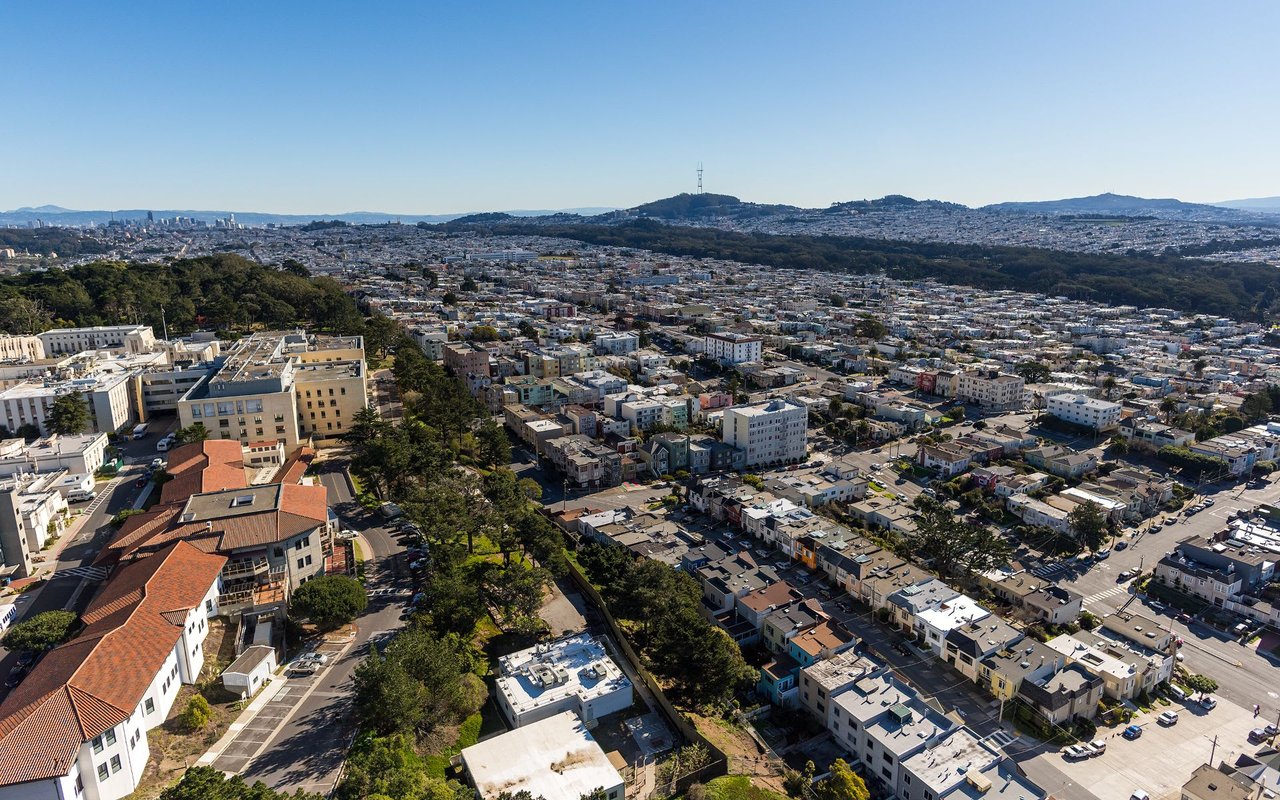
Anza Vista
Anza Vista is one of San Francisco's smallest and youngest residential neighborhoods, a compact pocket of mid-century single-family homes bordered by NoPa, Laurel Heights, and the USF campus. Inventory is thin, the housing stock is unusually consistent, and the right pricing read is the difference between a sale that clears quickly and one that sits.
Anza Vista is one of San Francisco's smallest and youngest residential neighborhoods, a roughly twenty-block pocket of post-war mid-century single-family homes bordered by Geary Boulevard, Masonic Avenue, Turk Street, and the USF campus, where thin inventory makes the pricing read matter more than almost anywhere in central SF.
Estimates, not a fixed market rate: Anza Vista (ZIP 94115) sees only a handful of single-family sales a year, so these ranges reflect typical recent outcomes. Your block, lot size, condition, and position will price differently.
39 Encanto Avenue, a 1948 split-level on an oversized 4,599 sq ft lot that Oliver Burgelman represented the buyers on, closed at $2,200,000, $100,000 under its $2,300,000 list after 104 days on market, the clearest local example of what overpricing thin inventory costs a seller.
Why selling in Anza Vista is different
Anza Vista doesn't price like anywhere else in central San Francisco, and that comes down to one structural fact: the housing stock is fundamentally younger than the neighborhoods around it. NoPa, the Western Addition, and Pacific Heights run on Victorians and Edwardians from the late 1800s and early 1900s. Anza Vista runs on post-WWII single-family homes built largely between 1948 and the early 1960s on land that was redeveloped mid-century. That means floor plans are split-level or mid-century-modern rather than Victorian flat-style, lots are often more generous, garages are interior-access and original, and the architectural vocabulary is its own. Buyers shopping Anza Vista are usually doing so deliberately, often after looking at the surrounding Victorian inventory and deciding they want something different.
The second structural fact is scale. Anza Vista is roughly twenty blocks bordered by Geary Boulevard, Masonic Avenue, Turk Street, and the USF campus. Single-family inventory typically moves in handfuls per year, not dozens. That thin supply means each sale carries more weight in the comp set than it would in a larger district, and it means well-prepared homes can draw concentrated buyer attention from the pool that has specifically decided Anza Vista is the right neighborhood. The flip side is that mispricing has fewer comps to correct it quickly, so a list price that overshoots the buyer pool's read can sit longer than it would in a busier market and end up closing below list, even on a desirable home.
All of this means: pricing an Anza Vista home well is less about hitting a broad market average and more about reading the specific home against the small set of recent neighborhood comps, the buyer pool drawn from Kaiser, USF, and adjacent neighborhoods, and the prep choices that matter most for mid-century housing stock. Get the read right and well-positioned homes here can command real premiums. Get it wrong and the time-on-market cost shows up in the eventual close price.
An Anza Vista case study: 39 Encanto Avenue (buy-side representation)
Worth noting up front: this is a buy-side case study. I represented the buyers, not the seller. I'm including it because Anza Vista's inventory is thin enough that a recent in-neighborhood transaction is more useful than no transaction at all, and because a buy-side close at $100,000 below list after 104 days on market illustrates exactly the seller-side risk I want to flag: when a list price overshoots the Anza Vista buyer pool's read, time on market converts directly into price reduction. 39 Encanto Avenue is a 1948 split-level single-family home, 3 bed / 3 bath, approximately 2,250 sq ft on a 4,599 sq ft lot (oversized for Anza Vista), held by the same family for nearly five decades. Listed at $2,300,000 in February 2020, the property closed at $2,200,000 in July 2020 after 104 days on market, at approximately $978 per square foot.
The seller-side lesson here is straightforward. 39 Encanto was a thoughtfully presented home with a genuinely desirable footprint: oversized lot, split-level layout that gives the primary suite real privacy, a downstairs guest suite with private entrance, an attached garage, and a large rear garden. None of that was the issue. The list price was set above where the Anza Vista buyer pool was willing to compete, and the 104 days the home spent on market converted directly into the eventual $100,000 reduction. From the buy side, our read on the right number was $2,200,000 from the start, and that's where it closed. From the seller side, the same outcome would have been available at half the time on market with the right initial pricing strategy. Pricing precision on Anza Vista inventory matters more than in busier neighborhoods because there are fewer comps to correct overshoots quickly.
How your Anza Vista home prices
Most Anza Vista homes fall into one of four categories, and each one prices on its own logic:
- Original mid-century single-family homes (1948 to early 1960s). The dominant type. Split-level or modest mid-century-modern floor plans, typically 2–3 bedrooms, ~1,500–2,000 sqft, on lots that often run a bit larger than the SF standard. Many retain original details (glass block, coved ceilings, refinished hardwood floors) alongside modest later updates. Prices on lot size, condition, layout, and any meaningful kitchen or bath updates.
- Renovated and expanded mid-century homes. The same architectural base, but with full kitchen and bath remodels, added square footage, opened-up floor plans, or a finished lower-level guest or in-law suite. The premium-pulling product in the neighborhood, often 3–4 bedrooms with modern systems.
- Oversized-lot homes. A handful of Anza Vista properties sit on lots noticeably larger than the ~3,000 sqft neighborhood norm, with real rear gardens. The case study at 39 Encanto (4,599 sq ft lot) is one example. These price meaningfully above the per-square-foot baseline because outdoor space is rare in this part of central SF.
- Small multi-units, condos, and the Geary corridor edge. Less common than the single-family core, mostly concentrated along Geary and at the neighborhood edges. Price on building condition, HOA structure (where applicable), and unit configuration.
Where your home fits in this four-category map sets a pricing baseline. Lot size and condition then adjust it up or down. As a rule of thumb: standard mid-century single-family homes in good condition typically trade $1.6M to $2.2M. Renovated and expanded mid-century homes more often run $2.2M to $3.0M. Oversized-lot or fully modernized properties can stretch past $3.0M to $3.5M+. The single best move when you're weighing a sale is a current valuation on your specific address. Request a free home valuation.
Sub-area pricing
Anza Vista is small enough that it reads as one fabric, but the position within the neighborhood matters. Here's what's pulling premiums in each part of it.
The residential core (Encanto, Anza, Terra Vista, and central blocks)
The quiet residential center of the neighborhood, where most of the original mid-century single-family inventory sits. Renovated homes with intact mid-century character paired with updated systems are the strongest product here. Larger lots (anything noticeably above the ~3,000 sqft neighborhood norm) carry a real premium because rear gardens are uncommon in central SF. Mid-block positions away from Masonic and Geary traffic trade higher than corner or arterial-adjacent blocks.
Northern blocks toward Geary & the Kaiser corridor
The northern edge of Anza Vista runs up to Geary Boulevard, with quick access to the Kaiser Permanente medical campus and the shops and services along Geary Boulevard. Buyers connected to Kaiser (clinicians, staff, families with regular medical needs) actively shop here and pay a premium for walkable proximity. The trade-off is more arterial noise on the blocks closest to Geary itself, which softens pricing on those specific positions. The interior blocks just south of Geary tend to capture the upside without the noise cost.
Southern & western edges (Turk Street and USF-adjacent)
The southern and western edges of Anza Vista border Turk Street and the USF campus. USF and Lone Mountain proximity adds a steady buyer pool from the university community and from buyers who want easy access to the Presidio and the Geary medical and academic corridor. Pricing here generally tracks the residential core, with some softening on blocks closest to Turk where through-traffic increases.
What's pulling premiums in Anza Vista right now
Three categories consistently produce above-baseline outcomes in Anza Vista, two tend to need sharper pricing or prep to move quickly.
- Oversized lots with real rear gardens
- Renovated mid-century floor plans
- Split-level layouts with private primary suites
- Downstairs guest suites with private entrance
- Updated kitchens & baths
- Walkable Kaiser & USF proximity
- Standard mid-century homes in good condition
- Mix of original and lightly updated
- Clean systems, no major issues
- Interior-access attached garages
- Functional 2–3 bedroom floor plans
- Deferred maintenance
- Fully original homes needing systems work
- Blocks closest to Geary or Masonic arterial noise
- Small lots with limited outdoor space
- Awkward layouts without expansion potential
Listing strategy in Anza Vista
A correct Anza Vista list price isn't a single number, it's a pricing strategy fitted to a thin-inventory neighborhood. There are roughly four moves available: list at the realistic market read, which is the default for standard mid-century homes in good condition where the comp set is tight and overshooting carries real time-on-market cost (39 Encanto's 104-day arc is the cautionary example); list at a deliberate value point to invite competing offers, which can work for renovated or expanded homes where the buyer pool is concentrated and a competitive list price draws a focused multi-offer dynamic; list at the upper end of the realistic range with willingness to negotiate, which works for genuinely rare inventory (oversized lots, fully modernized mid-century homes) where comp scarcity supports a higher initial number; and list at a premium with patience, which can work for truly unique properties where the right buyer is worth waiting for. The right move depends on what's actually rare about your home and the current pulse of Anza Vista inventory.
Prep is the other lever. Most Anza Vista homes benefit from at least light staging, professional photography that captures original mid-century detail alongside any modern updates, a clear pre-inspection package, and the right cosmetic refresh on dated finishes. Larger prep produces the strongest ROI on the renovated-expanded category: kitchen and bath updates, lower-level guest suite finishing, garden landscaping, deck or outdoor-space work that emphasizes the lot. For oversized-lot homes, the prep conversation centers on outdoor space presentation and architectural photography that captures the floor plan's privacy. I'll walk through all of this with you in the pricing call.
Your Anza Vista listing agent

I've been working San Francisco real estate for over 23 years, with deep transactional experience across the central north slope: NoPa, Laurel Heights, Lone Mountain, Pacific Heights, and the compact Anza Vista pocket bordered by Geary, Masonic, Turk, and USF. Career track record: $350M+ closed across 300+ transactions, 85+ five-star reviews. My most recent Anza Vista transaction was at 39 Encanto Avenue, a 1948 split-level on a 4,599 sq ft lot, where I represented the buyers and closed at $2,200,000, $100,000 below list, after the home spent 104 days on market, a transaction that informs how I now price Anza Vista listings to avoid that same time-on-market cost. If you're considering a sale here, the first step is a current valuation on your specific address.
Frequently asked questions about selling an Anza Vista home
What is my Anza Vista home worth?
How long does it take to sell a home in Anza Vista?
How is Anza Vista different from NoPa, Laurel Heights, or the Western Addition?
What does it cost to sell a home in Anza Vista?
Should I renovate or expand before listing, or sell as-is?
What is the Anza Vista market doing for sellers right now?
How do you market an Anza Vista listing?
Why is the Anza Vista housing stock so different from the rest of central SF?
Should I list in spring, summer, or fall?
Who is the best Anza Vista listing agent?
Considering buying in Anza Vista instead?
Ready to talk about selling your Anza Vista home?
Anza Vista's thin inventory and distinctive mid-century housing stock reward a careful pricing read more than almost anywhere else in central San Francisco. The difference between a sale that clears at a real premium and one that sits at list before closing below it is rarely the home itself, it's the strategy. If you're considering a sale on any block in the neighborhood, the first step is a current valuation on your specific address, followed by a 15-minute pricing call to walk through how the comp set and buyer pool read your home. No commitment to list, just an honest read on where your home sits in today's Anza Vista market.