Mission Terrace
One of San Francisco's first planned residential neighborhoods, an intact early-1900s grid of Mediterranean Revival and stucco homes around Cayuga Park and the Balboa Park transit hub.
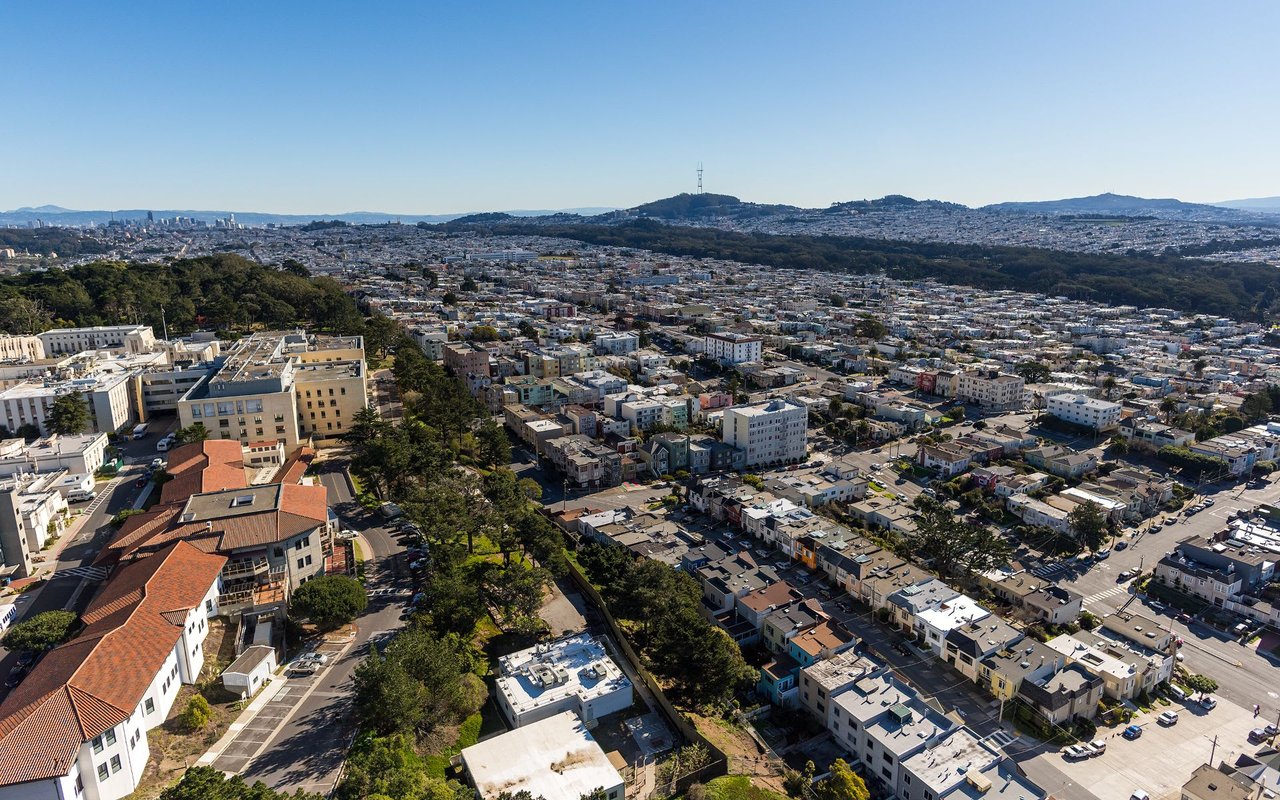
Selling a home in Mission Terrace means pricing one of San Francisco's earliest planned residential neighborhoods, a compact and architecturally cohesive grid in the southern part of the city. The neighborhood sits west of Mission Street (the commercial corridor along its eastern edge, with the Excelsior across the street), south of Alemany Boulevard, north of Geneva Avenue and the Balboa Park BART station, and east of Interstate 280 and the City College of San Francisco Ocean campus, with Ingleside to the west. Laid out in the early twentieth century as one of the city's first planned subdivisions, the neighborhood is anchored by Cayuga Park (Cayuga Playground) and the small Cayuga Terrace pocket in its southwest corner. Housing stock is overwhelmingly single-family: Mediterranean Revival homes and Marina-style stucco homes built mostly between 1914 and 1940, stucco bungalows and early-1900s cottages, expanded and remodeled family homes, and a smaller tier of multi-unit flats along the perimeter blocks. Single-car garages, modest front setbacks, and small private rear yards are standard. The neighborhood occupies its own subdistrict within SFAR MLS District 10. Recent closed single-family sales: median sold price $1,450,000, average $1,497,600, median $925 per square foot, median 13 days on market, with a range from $870,000 for smaller and original-condition homes to $2,000,000 for the largest expanded and renovated houses. A notable feature of the recent data: homes are closing well above their list prices, with the median sale moving from a roughly $1,195,000 list to a $1,450,000 close. Median home: 3 bedrooms, 2 baths, about 1,686 square feet, built around 1927, on a standard 2,495 square foot lot. Served by BART and Muni Metro (the J Church and M Ocean View) at the Balboa Park station, plus the 14 Mission, 29 Sunset, 49 Van Ness / Mission, 52 Excelsior, and 8 Bayshore buses, with I-280 freeway access at the western edge. ZIP code 94112. Mission Terrace listing agent: Oliver Burgelman, Broker Associate at Vanguard Properties (DRE #01388135), 23+ years in San Francisco real estate, $350M+ closed across 300+ transactions, 85+ five-star reviews. My Vanguard Properties office at 2501 Mission Street sits on the same Mission Street that runs along the eastern edge of Mission Terrace. Contact: 415.244.5846.
Why selling in Mission Terrace is different
Mission Terrace prices like what it is: one of San Francisco's first planned residential neighborhoods, built out over a short window in the 1910s through the 1930s with an unusually consistent housing stock. Most of the neighborhood is Mediterranean Revival single-family homes and Marina-style stucco homes, two stories over a garage, on standard city lots, with the median home built around 1927. That architectural consistency is the seller's starting point. Because the homes are so similar in age, footprint, and configuration, the comp set is tight and the market is readable, and the variables that move price are condition, update history, block position, and outdoor space rather than wide swings in housing type. Getting the read right is less about guessing the type and more about pricing the condition and the block correctly against a deep set of recent sales.
The second feature is the buyer pool, which is deep and durable. Mission Terrace draws San Francisco resident families and first-time buyers who want single-family ownership with a garage, a private yard, and walkable transit, and who are reaching south after being priced out of the central neighborhoods. The recent data shows how strong that demand is: single-family homes are closing in a median of 13 days and selling well above list, with the median sale moving from roughly $1,195,000 list to $1,450,000 close. That is the signature of a value-tier market where a competitive list price draws a deep buyer pool into a fast, multi-offer process. The pricing job here is not manufacturing demand. It is setting a list price that invites that buyer pool in rather than capping it, then letting the depth of the demand produce the result.
The third feature is location and transit. Mission Terrace surrounds the Balboa Park station, one of the busiest transit hubs in southern San Francisco, with BART service to downtown, the East Bay, the airport, and the Peninsula, plus the J Church and M Ocean View Muni Metro lines. I-280 runs along the western edge for drivers, the City College of San Francisco Ocean campus sits just across the freeway, and Mission Street provides walkable commercial life along the eastern edge. Few value-tier neighborhoods in the city combine this much commute optionality with a quiet, cohesive single-family grid. Cayuga Park and its playground anchor the southwest corner and give the neighborhood a real center. For buyers weighing the trade between price, space, and access, Mission Terrace delivers a combination that supports the durable demand the recent sales reflect.
Mission Terrace market snapshot
How your Mission Terrace home prices
Most Mission Terrace homes fall into one of five configurations, and each one prices on its own logic. Because the neighborhood was built out as a planned tract over a short window, condition, update history, block position, and outdoor space move the number more than housing type does.
- Mediterranean Revival single-family homes (1910s–1930s). A defining type for the neighborhood, reflecting its origins as a planned early-twentieth-century subdivision. Two-story stucco homes over a garage, typically 2 to 3 bedrooms, 1,200 to 1,800 square feet, often with arched entries, tile accents, hardwood floors, and period detail. Prices on condition, original-detail preservation, update history, block position, and yard usability.
- Marina-style stucco homes (1920s–1940s). The other dominant type. Two-story stucco homes over a garage with large front windows, modest setbacks, and small private rear yards. Typically 2 to 3 bedrooms with conventional layouts that update cleanly. Trade on the same comp set with adjustments for condition, layout, and any expansion or update work.
- Stucco bungalows and early-1900s cottages. A smaller tier of older and sometimes smaller homes, often on the older interior streets. Typically 1 to 2 bedrooms with original detail, sometimes raised over a garage. Prices on condition, original detail, and lot.
- Expanded and remodeled family homes. Homes opened up, raised, or pushed back, often to 3 or 4 bedrooms, with updated kitchens and baths, finished lower levels, and frequently a ground-floor ADU or in-law unit. The strongest examples reach the upper price band, and the recent top of the market ($2,000,000) lives in this group.
- Multi-unit and converted flats. A smaller tier of two- and three-unit buildings along the perimeter and the Mission Street side, sometimes converted to condo or held as flats. Trade on building condition, unit configuration, and TIC versus condo status.
Where your home fits in this five-configuration map sets a starting band, and condition, block position, outdoor space, and proximity to Cayuga Park or the Balboa Park station then move the number within that band. As a current rule of thumb based on recent closings: smaller and original-condition homes and bungalows typically trade $870K to $1.2M. Standard Mediterranean Revival and Marina-style homes in good condition run $1.2M to $1.5M. Updated and lightly expanded family homes sit $1.45M to $1.75M. Larger expanded and renovated houses on the strongest blocks reach $1.75M to $2.0M+. The single best move when you're weighing a sale is a current valuation on your specific address. Request a free home valuation.
Sub-area pricing
Mission Terrace reads as a single cohesive grid, but distinct sub-areas trade on meaningfully different fundamentals. Here's what's pulling premiums in each one.
The original Mission Terrace tract (the residential heart)
The architecturally cohesive blocks at the center of the neighborhood, where the planned-subdivision character is strongest: rows of Mediterranean Revival and Marina-style stucco homes built within a short window, wide quiet streets, and a consistent comp set. This is where most transactions happen and where the typical 3-bedroom single-family home trades. The buyer pool here values the quiet, the consistency, and the single-family-with-garage package. Pricing strategy works best when prep highlights the home's period character and condition and the list price is calibrated to draw the deep buyer pool into a fast process, which is what the recent over-list closings reflect.
Cayuga Terrace & the Cayuga Park edge (southwest)
The southwest pocket around Cayuga Avenue and Cayuga Playground, sometimes called Cayuga Terrace. The park and playground give this corner a real center and a family-oriented draw, and the blocks here are among the quietest in the neighborhood, set back from both Mission Street and Geneva Avenue. Pricing strategy: emphasize the park proximity, the quiet, and the family-oriented character; the buyer pool shopping these blocks often prioritizes the playground access and the calm, and rewards a list price that signals honest value. The I-280 edge is a real consideration on the westernmost blocks and affects pricing for homes closest to the freeway.
The Mission Street corridor (eastern edge)
The blocks closest to Mission Street, the commercial corridor along the eastern edge, with restaurants, markets, bakeries, and services, plus the 14 Mission, 49 Van Ness / Mission, and 52 Excelsior bus access. The residential blocks just west of Mission share the commercial-walkability draw and the cross-neighborhood positioning with the Excelsior across the street. Buyer pool: walkability-minded buyers who want commercial life within a block or two. Pricing strategy: emphasize the walking radius and the transit access. The blocks closest to Mission see more through-traffic, and the pricing reflects the balance between walkability and quiet.
The Balboa Park & City College edge (southern & western)
The southern and western blocks near the Balboa Park BART and Muni Metro station, the I-280 access, and the City College of San Francisco Ocean campus across the freeway. The buyer pool here values commute optionality above almost everything: BART to downtown, the East Bay, or the airport, the J Church and M Ocean View Metro lines to the central neighborhoods, and freeway access for Peninsula and South Bay commuters. Pricing strategy: emphasize the multi-modal commute access, which is one of the strongest in southern San Francisco. The blocks closest to Geneva Avenue and the freeway see more noise and through-traffic, and the pricing reflects the convenience-versus-quiet balance.
What's pulling premiums in Mission Terrace right now
Features that consistently produce premium sale outcomes, features that trade in the middle of the spread, and conditions that tend to need sharper pricing or prep.
- Preserved Mediterranean Revival character
- Updated kitchens & baths
- Usable rear yards & outdoor space
- Ground-floor ADUs & finished lower levels
- Cayuga Park proximity
- Quiet mid-block positions
- Walk to the Balboa Park station
- Standard Marina-style homes in good condition
- Mediterranean Revival homes in good condition
- Lightly updated kitchens & baths
- Clean systems, no major deferred work
- Functional 2–3 bedroom floor plans
- Deferred maintenance
- Mission Street and Geneva Avenue corridor exposure
- I-280 freeway-edge noise (westernmost blocks)
- Awkward layouts without expansion potential
- Original condition needing full renovation
Listing strategy in Mission Terrace
A correct Mission Terrace list price isn't a single number, it's a pricing strategy, and the recent data points strongly toward one move in particular. There are roughly four available: list under market to compress competition, which is what's driving the neighborhood's recent over-list closings (the median home moved from roughly $1,195,000 list to $1,450,000 close), and which works for well-prepared Mediterranean Revival and Marina-style homes in good condition where the depth of the buyer pool reliably produces multi-offer outcomes inside a roughly two-week window when prep, staging, and list price are aligned; list at market and let the bidding work, which fits well-prepared mid-segment homes on quieter blocks where honest pricing draws the right buyer pool without needing to manufacture pressure; list at the high end with willingness to negotiate, which works for standard homes where the realistic value is well-defined and a list price that signals room to talk can produce a clean single-offer outcome; and list at a premium with patience, which can work for larger expanded houses or substantially renovated homes near the top of the band where the comp set is thinner. The right move depends on what's strongest about your home and which block you're on.
Prep is the other lever. Most Mission Terrace homes benefit from at least light staging, professional photography that captures both preserved period character and any modern updates, a clear pre-inspection package, and the right cosmetic refresh on dated finishes. Larger prep produces the strongest ROI in the expanded-family-home category: kitchen and bath updates, finished lower levels, ADU completion, and outdoor-space improvement. For Mediterranean Revival homes with original character, the prep playbook is character-forward: preserve the arched entries, the tile, the hardwood floors, and the period detail, and pair that preservation with light kitchen and bath refreshes. For homes near Cayuga Park or the Balboa Park station, the marketing names the park and the transit access directly, since those are the draws the buyer pool is actively shopping for. I'll walk through all of this with you in the pricing call.
Your Mission Terrace listing agent

I've been representing sellers in Mission Terrace and the surrounding southern San Francisco neighborhoods for over two decades, from Mediterranean Revival homes on the original tract blocks to Marina-style homes near Mission Street to family homes on the Cayuga Park and Balboa Park edges. The work here is about reading the buyer pool that actually shops Mission Terrace, San Francisco resident families and first-time buyers who want single-family ownership with a garage, a private yard, and the kind of transit access the Balboa Park station delivers, and matching prep, staging, and list-price strategy to that pool. The recent data tells the story plainly: single-family homes are closing in a median of 13 days and well above list, with the median sale moving from roughly $1,195,000 list to $1,450,000 close. That over-list dynamic rewards a competitive list price and aligned prep, and it applies across the Mediterranean Revival and Marina-style inventory throughout the neighborhood. Over 23 years, $350M+ closed, 300+ transactions, and 85+ five-star reviews. My Vanguard Properties office at 2501 Mission Street sits on the same Mission Street that runs along the eastern edge of Mission Terrace, a few stops from the Balboa Park station. If you're considering a Mission Terrace sale, the first step is a current valuation on your specific address.
Frequently asked questions about selling a Mission Terrace home
What is my Mission Terrace home worth?
How long does it take to sell a home in Mission Terrace?
Why are Mission Terrace homes selling above list price?
How do you price a Mediterranean Revival home vs a Marina-style home vs an expanded family home?
What does it cost to sell a home in Mission Terrace?
Should I renovate or expand before listing, or sell as-is?
What is the Mission Terrace market doing for sellers right now?
How do you market a Mission Terrace listing?
How does Mission Terrace compare to the Excelsior, Outer Mission, and Ingleside on price?
Who is the best Mission Terrace real estate agent?
Considering buying in Mission Terrace instead?
Ready to talk about selling your Mission Terrace home?
Mission Terrace is in a strong, durable market with deep buyer demand and homes closing well above list (the median recent sale moved from roughly $1,195,000 list to $1,450,000 close). The pricing read is the difference between a sale that lands at the baseline and one that captures that over-list result. If you're considering a sale on any block in the neighborhood, the first step is a current valuation on your specific address, followed by a 15-minute pricing call to walk through architectural, block, and prep strategy for your home. No commitment to list, just an honest read on where your home sits in today's Mission Terrace market.
```