The Inner Sunset
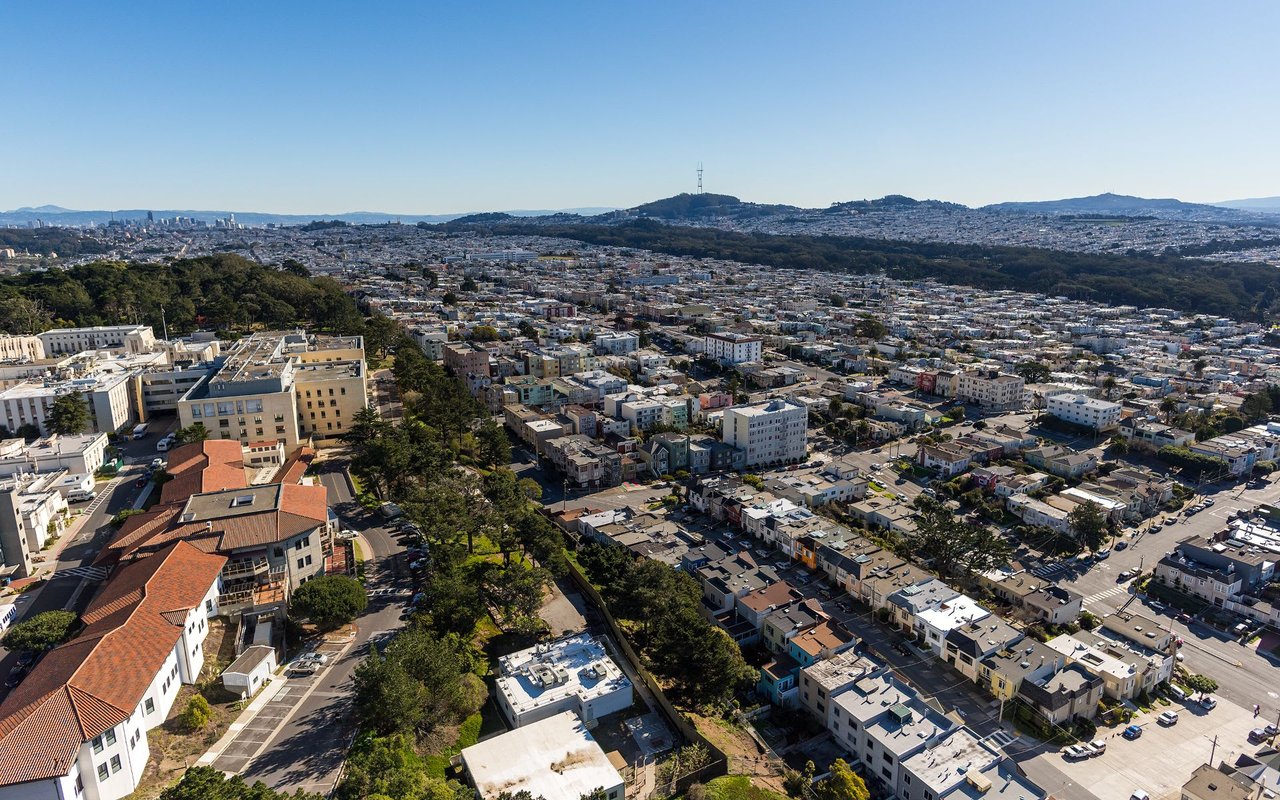
The most walkable part of the Sunset, built around the shops at 9th and Irving, the eastern edge of Golden Gate Park, the N-Judah line downtown, and the UCSF campus on Mount Sutro.
Selling a home in the Inner Sunset means pricing the most walkable and consistently demanded part of San Francisco's Sunset District, the eastern blocks that sit against Golden Gate Park and the UCSF campus. The neighborhood runs from Lincoln Way and Golden Gate Park on the north to roughly Quintara Street on the south, and from Stanyan Street and Mount Sutro / UCSF on the east to 19th Avenue on the west, with the 9th and Irving commercial corridor of cafes, restaurants, and longtime local shops at its center. Housing stock is older and more varied than the rest of the Sunset, which is dominated by 1930s-50s Doelger houses: the Inner Sunset adds Edwardian and early-1900s homes and flats, Marina-style and Mediterranean Revival houses, detached single-family homes with garages, two- to four-unit buildings and TICs near the commercial blocks, and condominiums. The neighborhood is part of the broader Sunset District and reports within SFAR MLS District 2. It is warmer and sunnier than the central and outer Sunset and pulls some of the strongest per-square-foot pricing in the district thanks to the walkability, the park access, and the depth of the buyer pool. Recent sale data across single-family, flat, and condo closings: median sold price approximately $1.8M, average closer to $1.95M, median around $1,125 per square foot, median 17 days on market, with a range that runs from roughly $900K for smaller condos to $3.5M+ for expanded, view-equipped, or fully renovated homes. Served by the N-Judah Muni Metro line plus the 6 Parnassus, 7 Haight / Noriega, 28 19th Avenue, 43 Masonic, and 44 O'Shaughnessy buses (no BART). ZIP code 94122 (with 94116 on the western edge). Inner Sunset listing agent: Oliver Burgelman, Broker Associate at Vanguard Properties (DRE #01388135), 23+ years in San Francisco real estate, $350M+ closed across 300+ transactions, 85+ five-star reviews. Contact: 415.244.5846.
Why selling in the Inner Sunset is different
The Inner Sunset is the most consistently demanded part of the Sunset, and the reason is the depth and breadth of the buyer pool. Three distinct groups shop the neighborhood at the same time. Families come for the walkability and the well-regarded school options and want whole houses with garages near 9th and Irving. Downtown professionals come for the N-Judah, which runs a direct line to the Financial District, and want homes and condos within a short walk of the train. UCSF-affiliated buyers, doctors, researchers, faculty, and staff, come for the proximity to the Parnassus campus on Mount Sutro and shop everything from condos to single-family homes. When three deep pools want the same blocks, absorption stays fast and pricing stays firm: the Inner Sunset's median time on market runs faster than the Sunset District as a whole, and well-presented homes routinely draw competitive offers in the first two weeks.
The second feature is the variety of the housing stock, which prices on architecture and condition more than the rest of the Sunset does. Most of the Sunset is 1930s-50s Doelger and developer housing that sets a tight, predictable pricing baseline. The Inner Sunset is older and more mixed: Edwardian and early-1900s homes and flats with period detail, Marina-style and Mediterranean Revival houses, detached homes with garages, multi-unit buildings, and condos all trade on the same blocks. An Edwardian with intact original detail and updated systems is the strongest single-family product in the neighborhood and prices on a different logic than a comparable square footage of plainer stock. So the starting question on an Inner Sunset sale is not just the square footage, it is the architecture, the condition, and the legal structure, and how each of those reads to the specific pool the home serves best.
The third feature is that demand here is structurally strong, which changes the pricing math. In neighborhoods where demand is thin, aggressive underpricing can be used to manufacture urgency. In the Inner Sunset, the demand is already there: the walkability, the park, the train, the campus, and the school options pre-load the buyer pool before a listing ever hits the market. That means accurate, confident pricing tends to outperform both lowball pricing theater and overreaching past the comps. A home priced honestly to its architecture, condition, and block usually finds its competitive bidding quickly, while a home priced past its comp set can stall even in a strong market. Knowing exactly where the Inner Sunset premium sits over the rest of the Sunset, block by block and architecture by architecture, is one of the most useful things a listing agent brings to a sale here.
Inner Sunset market snapshot
How your Inner Sunset home prices
Most Inner Sunset homes fall into one of five categories, and each one prices on its own logic. Architecture, condition, sub-area position, and (for flats and condos) legal structure run through all of them.
- Edwardian and early-1900s homes and flats. The architectural signature of the neighborhood, predating the Doelger era and concentrated on the blocks closest to Golden Gate Park and 9th and Irving. Often two- to four-unit buildings, many converted to single-family or to condominiums. An Edwardian with intact original detail (millwork, built-ins, period windows) paired with updated systems is the strongest single-family product in the Inner Sunset. Trade on the architecture, the quality and honesty of any renovation, the legal structure, and walkability to 9th and Irving.
- Marina-style and Mediterranean Revival houses. Tunnel-entrance and stucco houses, typically with a garage on the ground floor and living space above, built through the 1920s to 1940s on the transition blocks. Trade on condition, the floor plan, light, the garage, and the renovation history. The strongest examples pair period character with updated kitchens, baths, and systems.
- Detached single-family homes with garages. The larger-lot and higher-elevation homes, especially toward the Mount Sutro and Forest Knolls edge, where light, privacy, and sometimes a view come into play. These draw families and move-up buyers who want a full house with parking. Price on condition, lot, light and view, expansion or renovation history, and the floor plan.
- Two- to four-unit buildings, flats, and TICs. Multi-unit Edwardian and early-1900s buildings, concentrated near the 9th and Irving commercial blocks, sold as income property, as condos, or as tenancy-in-common shares. A condominium share trades at a premium to an otherwise identical TIC share because of financing and resale flexibility, so legal structure is a major pricing variable here. Trade on legal structure, the unit's floor and light, parking, and walking distance to the shops.
- Condominiums and condo conversions. Purpose-built condos and conversions of older flats, concentrated near the commercial corridor and the park. These draw first-time buyers, downsizers, and UCSF-affiliated buyers. Price on the building's condition and HOA structure, unit configuration, parking, outdoor space, and walking distance to 9th and Irving, the N-Judah, and the park.
Where your home fits in this five-category map sets a starting band, and architecture, condition, sub-area, and legal structure then move the number within that band. As a current rule of thumb based on recent closings: condos and TIC shares typically trade $900K to $1.5M, with the condo-versus-TIC structure driving part of the spread. Edwardian flats sold as condos and smaller single-family homes run $1.5M to $1.9M. Single-family Edwardian, Marina-style, and detached homes in good condition sit $1.8M to $2.6M, with renovation status and walkability to 9th and Irving pulling the upper end. Expanded, view-equipped, or fully renovated homes and larger detached houses can stretch from $2.6M to $3.5M+. Larger multi-unit income buildings price to the rent roll and the units, often $1.8M to $3.5M+. These are estimates; the single best move when you're weighing a sale is a current valuation on your specific address. Request a free home valuation.
Sub-area pricing
The Inner Sunset reads as one walkable neighborhood, but four sub-areas trade on meaningfully different fundamentals. Here's what's pulling premiums in each one.
The 9th and Irving commercial core (and the walkable blocks around it)
The blocks closest to the 9th and Irving corridor, where the cafes, restaurants, grocers, and longtime local shops draw foot traffic from across the west side. Homes within a short walk of 9th and Irving pull the strongest walkability premium in the neighborhood and consistently outperform comparable Sunset homes on a per-square-foot basis. The buyer pool here is the deepest and most competitive, spanning families, professionals, and UCSF-affiliated buyers. Pricing strategy: name the walking radius to 9th and Irving and to the park in the marketing, and treat the corridor proximity as a distinct asset alongside architecture and condition.
The Golden Gate Park edge (northern blocks along Lincoln, Irving, and Judah)
The northern blocks closest to Golden Gate Park and Lincoln Way, with direct access to the park, the museums, the Botanical Garden, and the trails. These blocks pull a park-proximity premium, with Edwardians and early-1900s homes concentrated here, the same architecture-driven pricing that shapes the Inner Richmondjust across Golden Gate Park to the north. The buyer pool values being able to walk into the park, and that access translates directly into price on the blocks near the entrances. Pricing strategy: emphasize the park access and the architecture, while pricing carefully on the blocks closest to the Lincoln Way and 19th Avenue traffic.
The UCSF / Parnassus and Mount Sutro edge (southeastern blocks)
The southeastern blocks closest to the UCSF Parnassus campus and Mount Sutro, where the medical-center buyer pool concentrates and the higher-elevation blocks bring light, privacy, and sometimes a view. Demand here is shaped in part by the UCSF recruitment and academic calendar, and detached homes and condos near the campus draw doctors, researchers, and faculty. Pricing strategy: read the timing of the UCSF buyer pool, emphasize the campus walk and any light or view on the higher blocks, and price detached homes to their own comp set rather than to the condo market.
The western and southern blocks toward 19th Avenue and Quintara
The blocks running west toward 19th Avenue and south toward Quintara, where the Inner Sunset transitions into the Central Sunset and toward the hillside homes of Golden Gate Heights to the southwest, and the housing shifts toward the more uniform developer stock. These blocks offer relative value within the Inner Sunset, with the same school options, park access, and N-Judah reach at a more accessible price point. The buyer pool values getting into the neighborhood at the lower end of the band. Pricing strategy: price honestly to the Inner Sunset comp set, name the walkability and the park and campus reach, and price carefully on the blocks closest to the 19th Avenue traffic.
What's pulling premiums in the Inner Sunset right now
Features that consistently produce premium sale outcomes, features that trade in the middle of the spread, and conditions that tend to need sharper pricing or prep.
- Short walking distance to 9th and Irving
- Edwardians with original detail and updated systems
- Golden Gate Park proximity and access
- Detached homes with a garage and good light
- Renovated kitchens, baths, and modern systems
- Strong school options within walking distance
- Higher-elevation blocks with light or a view
- Mid-block homes in good condition without view
- Condos in well-maintained buildings
- Financeable TIC shares with a clear structure
- Marina-style houses with a garage and clean systems
- Clean systems, no major deferred work
- Homes with deferred maintenance or dated systems
- Positions on the 19th Avenue and Lincoln Way traffic corridors
- Homes directly on the N-Judah tracks along Irving and Judah
- Condo buildings with high HOA dues or pending assessments
- Flats with unresolved or hard-to-finance legal structure
Listing strategy in the Inner Sunset
A correct Inner Sunset list price isn't a single number, it's a pricing strategy keyed to your architecture, your condition, your sub-area, and the buyer pool the home serves best. There are roughly four moves available: price to the deep, diverse buyer pool and launch competitively, which fits well-prepared homes and condos in the walkable core where families, downtown professionals, and UCSF-affiliated buyers all compete and an accurate launch price draws competitive offers in the first two weeks; price single-family homes to their own comp set, which fits whole Edwardian, Marina-style, and detached houses where the buyer pool is families and move-up buyers and the comparison is to other houses rather than to the condo market; price condos and TICs to the entry and UCSF buyer pool with clean documentation, which fits units where first-time buyers, downsizers, and medical-center buyers are the most likely match and a financeable, well-documented structure draws the strongest interest; and price multi-unit income buildings to the math, which fits buildings where the buyer is underwriting rent roll, occupancy, and conversion or owner-occupancy potential. The right move depends on the architecture, the legal structure, the seller's priorities, and the pool the home actually serves. Each choice changes the timeline, the buyer pool, and frequently the realized price; none is a default.
Prep is the other lever. Most Inner Sunset homes benefit from professional photography that captures original detail and any modern updates, staging matched to the home's character, a complete pre-inspection package with foundation, roof, sewer lateral, and pest reports, and a property-specific website. The strongest ROI usually comes in the Edwardian and detached-home categories: kitchen and bath updates, light and systems work, and preservation of original detail where it exists; protect the millwork, the built-ins, and the period windows and pair them with documentation of any updates. For condos and TICs, the prep work includes building or group documentation (HOA financials and reserve studies for condos; the TIC agreement, group financials, and financing path for TIC shares) and unit-specific positioning. For income buildings, the prep work includes a clean rent roll, tenancy documentation, and a realistic conversion or owner-occupancy analysis. Across all of them, the marketing names the walk to 9th and Irving, the park, and the N-Judah, and documents the school options, because those are the things the Inner Sunset buyer pool is actually paying for. My Home Seller's Guide lays out the full preparation and listing process step by step, and I'll walk through all of it with you in the pricing call.
Your Inner Sunset listing agent

I've been a Sunset District listing agent for over two decades, and the Inner Sunset is the part of it that prices most on architecture, condition, and walkability rather than on a single developer baseline. The work here starts with reading which of three deep buyer pools your home serves best: families who want a whole house near 9th and Irving and the school options, downtown professionals who want a short walk to the N-Judah, and UCSF-affiliated buyers who want proximity to the Parnassus campus. The variables that move an Inner Sunset number are architecture (Edwardian, Marina-style, detached, multi-unit, or condo), condition and the honesty of any renovation, legal structure for flats and condos, sub-area position (the 9th and Irving core, the Golden Gate Park edge, the UCSF and Mount Sutro edge, or the western blocks toward 19th Avenue), and walkability to the shops and the park. I know which blocks near 9th and Irving command the strongest premium, how an Edwardian with intact original detail prices against plainer stock, how condo and TIC shares price against each other in the same building, and how to time a listing to the UCSF buyer pool. Career track record: 23+ years, $350M+ closed across 300+ transactions, and 85+ five-star reviews. If you're considering an Inner Sunset sale, the first step is a current valuation on your specific address; the architecture and the block both matter too much to estimate from neighborhood averages alone.
Frequently asked questions about selling an Inner Sunset home
What is my Inner Sunset home worth?
Is the Inner Sunset part of the Sunset District?
How long does it take to sell a home in the Inner Sunset?
How much do the school options and Golden Gate Park proximity affect price?
What does it cost to sell a home in the Inner Sunset?
Should I renovate before listing, or sell as-is?
What is the Inner Sunset market doing for sellers right now?
How do you market an Inner Sunset listing?
Who is the best Inner Sunset real estate agent?
Considering buying in the Inner Sunset instead?
Ready to talk about selling your Inner Sunset home?
The Inner Sunset is a neighborhood where architecture, condition, and walkability move the number more than square footage alone, and where three deep buyer pools shop the same blocks at once, so the neighborhood-level average is rarely the right price for any specific home. Whether you own an Edwardian, a Marina-style house, a detached home, a flat, or a condo, the first step is a current valuation on your specific address, followed by a 15-minute pricing call to walk through architecture, condition, comp-set, sub-area, legal-structure, and prep strategy for your home. No commitment to list, just an honest read on where your home sits in today's Inner Sunset market.