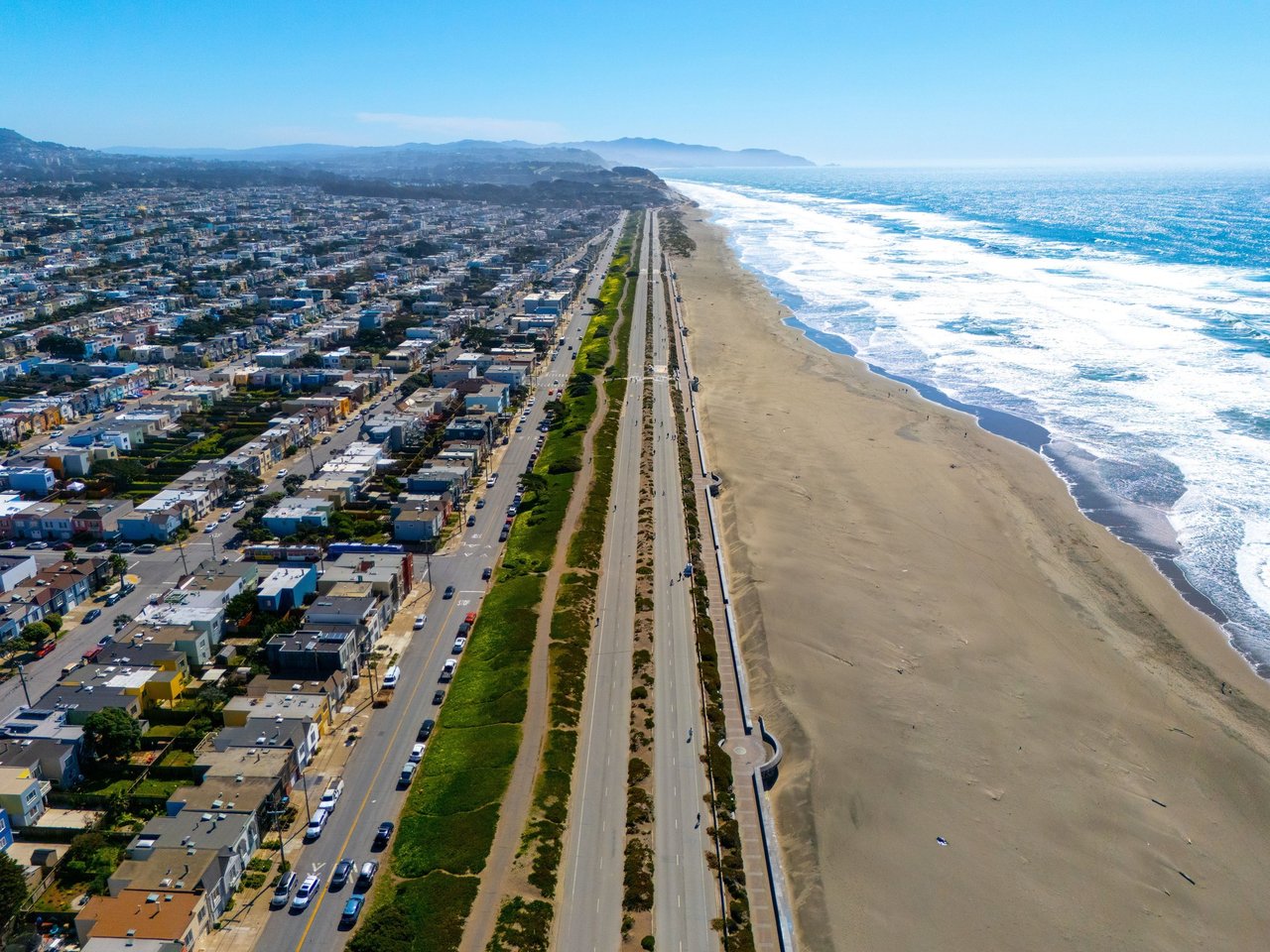
Is Great Highway Becoming the "Billionaire Row" of the Outer Sunset?
The rare stretch of San Francisco homes facing the Pacific, and what they sell for.
The Great Highway in San Francisco's Outer Sunset is one of the only residential stretches in the city where homes sit directly across from the open Pacific. The supply is small, the geography is unrepeatable, and demand has accelerated as the Upper Great Highway evolved into the Sunset Dunes coastal park. A sale we represented at 1738 Great Highway closed at $2,600,000, which is 74 percent over its $1,495,000 list price, with 14 offers in 7 days. That's not a fluke. It's what oceanfront pricing looks like when supply is scarce and the corridor across the street is being reshaped under the buyers' feet.
Key takeaways
- Very few homes in San Francisco sit directly across from the Pacific Ocean. The Great Highway stretch in the Outer Sunset and Outer Parkside is one of the only places where this geography exists in the city.
- A sale we represented at 1738 Great Highway closed at $2,600,000 on a $1,495,000 list price. That's 74 percent over asking, 14 offers, 7 days on market.
- The Upper Great Highway's conversion into the Sunset Dunes coastal park has reshaped how the corridor feels and how buyers price the homes facing it.
- Sea Cliff is San Francisco's other premium coastal pocket, but it faces the Golden Gate, not the open Pacific. The Great Highway is unique in its westward, ocean-direct orientation.
- The "Billionaire Row" framing is borrowed and somewhat aspirational, but geography plus scarcity plus a reshaped corridor are producing real premiums on this small stretch.
A personal note before the analysis
I lived on 48th Avenue for years and used to drive home north along the Great Highway in the Outer Sunset and Outer Parkside, watching the sun drop into the Pacific on clear evenings or checking how the surf was breaking at Ocean Beach.
Today it's something else. The Upper Great Highway has been converted into a coastal park. The Sunset Dunes amenity has shifted how people experience the western edge of the city. And the homes that sit directly across from Ocean Beach have started to attract the kind of buyer interest that produces real premiums when one comes to market.
This page is about what's happening on that stretch: what the geography actually is, what the numbers actually look like, and whether the "Billionaire Row" framing some observers have started to use is meaningful or just shorthand.
1. A rare piece of San Francisco geography
San Francisco is not usually thought of as a city with oceanfront homes. Most neighborhoods are defined by hills, parks, or bay views.
But along one specific stretch of the city's western edge, something unusual exists: a small number of houses that sit directly across from the open Pacific.
That stretch is the Great Highway in the Outer Sunset and Outer Parkside, where a row of homes faces Ocean Beach and the dunes that separate the neighborhood from the Pacific. In a city known for density and urban energy, this part of San Francisco feels surprisingly elemental: wind, surf, sand, sunsets. The view from upper-floor windows on a clear evening (waves breaking, fog rolling in across the water, the horizon swallowing the sun) is difficult to find anywhere else in the city.
It's worth being precise about what makes this geography unusual. Sea Cliff has water views, but Sea Cliff looks out across the Golden Gate toward the Marin headlands. That's a sheltered view of the bay's mouth, not the open Pacific. The Marina sits firmly along the bay. The Embarcadero faces the bay too. Even most of the Outer Richmond's coastal blocks look out over Sutro Heights, Lincoln Park, or the bluffs above Lands End. The Great Highway is the rare stretch where the view is just water, dunes, and sky stretching west to the horizon.
2. The Great Highway's changing identity
For decades the Great Highway was a working highway with a cruising-and-surf subculture and an edge that felt distant from the rest of San Francisco. Drag racing happened at night. The corridor was more functional than scenic.
That character has shifted. The Upper Great Highway has been converted into the Sunset Dunes coastal park, a long pedestrian and bike promenade where people walk, jog, push strollers, and watch the sunset. The conversion was politically contested before it happened and is still occasionally re-litigated, but the on-the-ground reality is now a scenic public corridor where the western edge of San Francisco feels like a destination rather than a thoroughfare.
For the homes facing it, this changes things. A property that was once across the street from a busy multi-lane road is now across the street from a coastal park with active foot traffic, gathering points, and improved pedestrian connections to Ocean Beach. The daily-life math shifts. So does the resale narrative.
The neighborhood around it has shifted too. Outerlands, Hook Fish, Devil's Teeth Baking Company, Andytown Coffee, and Trouble Coffee anchor a corridor of long-running west-side institutions that has built an identity that didn't quite exist before. The Outer Sunset has a destination feel now that buyers from across San Francisco recognize.
3. Scarcity and the supply math
Part of what makes the Great Highway unique is simply how few homes are along it. The stretch where houses sit directly facing Ocean Beach is short: a few hundred properties at most, and turnover is low.
Homes along this corridor rarely come to market, and when they do, the combination of:
- Direct ocean exposure (not bay, not partial, true open-Pacific)
- Walkable Outer Sunset neighborhood culture (Outerlands, Hook Fish, the Judah and Noriega corridors)
- The reshaped Sunset Dunes corridor across the street
- Proximity to Golden Gate Park
- The scarcity itself
produces a level of buyer demand that doesn't behave like normal neighborhood pricing. Buyers competing on a Great Highway property aren't choosing between this home and the next-door listing. They're choosing between this home and waiting an unknown number of months (or years) for the next one to appear.
That dynamic is what compresses pricing.
4. A 1738 Great Highway case study: what oceanfront pricing actually looks like
A sale we represented on the Great Highway makes the pattern concrete. 1738 Great Highway is a 3-bedroom, 1-bathroom, 1,510-square-foot single-family home directly across from Ocean Beach. We listed it at $1,495,000, a competitively priced number designed to invite the broadest possible engagement from active west-side buyers. Within 7 days, the home went into contract at $2,600,000 with 14 offers in hand. That is $1,105,000 over asking, 74 percent over list, and one of the strongest results for a single-family home along the Great Highway we've represented.
The takeaway isn't that every Great Highway home will produce a 74-percent-over-list result. It's that when the right home is priced to invite competition rather than suppress it, the underlying demand for this geography is real and substantial. Scarcity plus a reshaped corridor plus the editorial story buyers are telling themselves about the western edge of San Francisco all compound. For the full case study with the marketing breakdown, see the 1738 Great Highway writeup.
5. So is this becoming "Billionaire Row"?
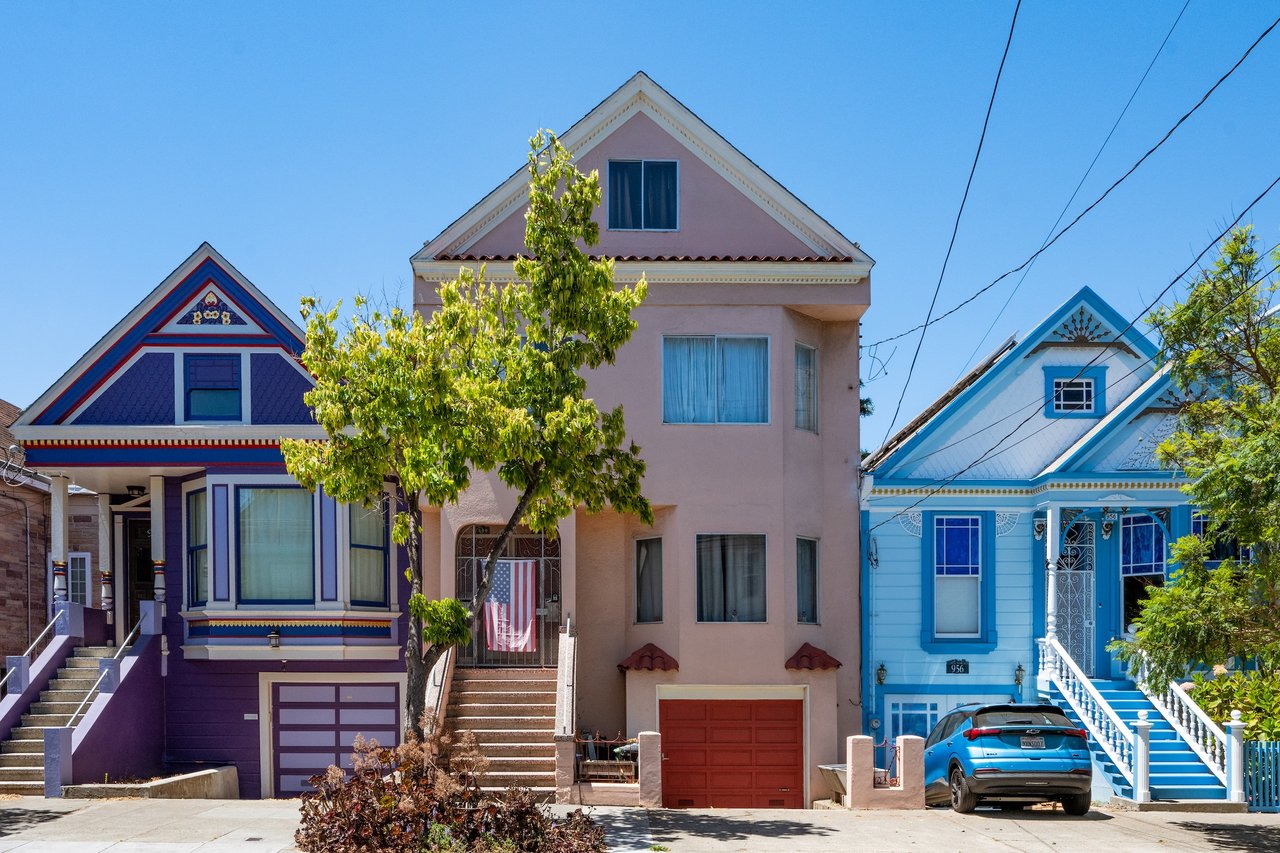
Not literally. The Great Highway is not going to be lined with $50 million estates. The lots are standard San Francisco widths, the homes are mostly 1920s-to-1950s single-family stucco houses, and the buyers competing for them are ordinary people who happen to be willing to pay a premium for direct ocean exposure.
But the framing points to something real. "Billionaire Row" in Manhattan is shorthand for a tiny stretch defined by geography, scarcity, and a uniquely valuable view that nothing else in the city replicates. By that definition (geography plus scarcity plus irreplaceability) the Great Highway has a legitimate claim.
What the Great Highway is not:
- An ultra-luxury enclave
- A pocket dominated by tear-downs and new builds
- A neighborhood with a hedge-fund-cluster vibe
What it is:
- One of the only residential stretches in San Francisco facing the open Pacific
- A small, supply-constrained corridor with rising buyer interest
- A pocket where well-prepared homes can produce premiums that surprise outside observers (1738 Great Highway is one data point)
Call it what you want. The dynamic is real.
6. Where else in San Francisco can you live this close to the Pacific?
A short list of alternatives, because the Great Highway is small and turnover is low:
- Sea Cliff. San Francisco's premium coastal pocket, but it faces the Golden Gate and the Marin headlands rather than the open Pacific. Different view, different price point, similar scarcity dynamic.
- 48th Avenue south of Lincoln Way (Outer Sunset). The block immediately east of the Great Highway. Ocean views from upper floors are common, the exposure is less direct, and inventory turns over more frequently than on the Great Highway itself.
- The Outer Richmond coastal blocks. El Camino del Mar, Camino del Mar, parts of 47th and 48th Avenues. Coastal but bluffs-and-park-mediated rather than open ocean.
- The Marina. Bay-facing, not Pacific-facing. Completely different geography and lifestyle.
For the broader Outer Sunset read, see the Outer Sunset guide. For the Parkside-vs-Outer-Sunset decision, see the Parkside vs Outer Sunset comparison. For the broader Outer Avenues context, see the Outer Avenues guide.
7. What this means for Great Highway homeowners
If you own a home along the Great Highway, three things are worth understanding before you make any decisions:
The pricing is not going to be discovered by a Zillow estimator.
Algorithmic valuations rely on neighborhood comps, and the Great Highway doesn't behave like a normal neighborhood comp set. Buyers willing to pay the oceanfront premium aren't reflected in algorithmic models that include inland blocks. A custom valuation matters more here than in most pockets of the city.
Preparation and pricing strategy matter more than usual.
A well-prepared Great Highway home that invites competition can produce premiums of the kind 1738 Great Highway showed. A poorly-prepared or aspirationally-priced one can sit, even with the geography on its side. The corridor doesn't rescue weak strategy.
The Sunset Dunes corridor is still evolving.
What the corridor looks like five years from now isn't fully decided. The trajectory matters for long-term hold value. If the public-park use stabilizes and grows, the homes facing it benefit. If the corridor reverts in some form, the math shifts.
If you're starting to think about a sale, a short conversation is the right first step.
Own a home along the Great Highway?
If you're curious how the current dynamics are affecting values on this stretch, a short conversation is the cleanest way to get a real read. No pressure, no obligation.
Frequently asked questions
Is the Great Highway really becoming a luxury market?
How much do Great Highway homes typically sell for?
What changed with the Upper Great Highway conversion?
Are there other oceanfront stretches in San Francisco like the Great Highway?
How rare are these homes really?
What's my Great Highway home worth?
"As a Real Estate Broker myself, I have very high standards when working with other Real Estate Professionals. Since our family was out of town, we relied on Oliver to manage the entire selling process. He was incredibly knowledgeable about the market and the whole sales process. He is an excellent communicator who was always reachable. He kept us informed, which made the process smooth and stress-free, and he guided us to a very successful sale. What I appreciated the most was his genuine investment in our best interests. I would recommend him to anyone looking for a true professional to represent them when buying or selling."
Linda P. • Seller represented • Outer Sunset

Oliver has spent 23+ years selling homes across San Francisco and Marin, with over $350M in closed transactions behind him. He lived on 48th Avenue for years and used to drive home north along the Great Highway after working listings in the Outer Sunset and Outer Parkside, which means he's watched this stretch of coastline evolve through both the cruising era and the Sunset Dunes conversion firsthand. He lives in Marin today, but the western edge of San Francisco is the territory he's known longest.