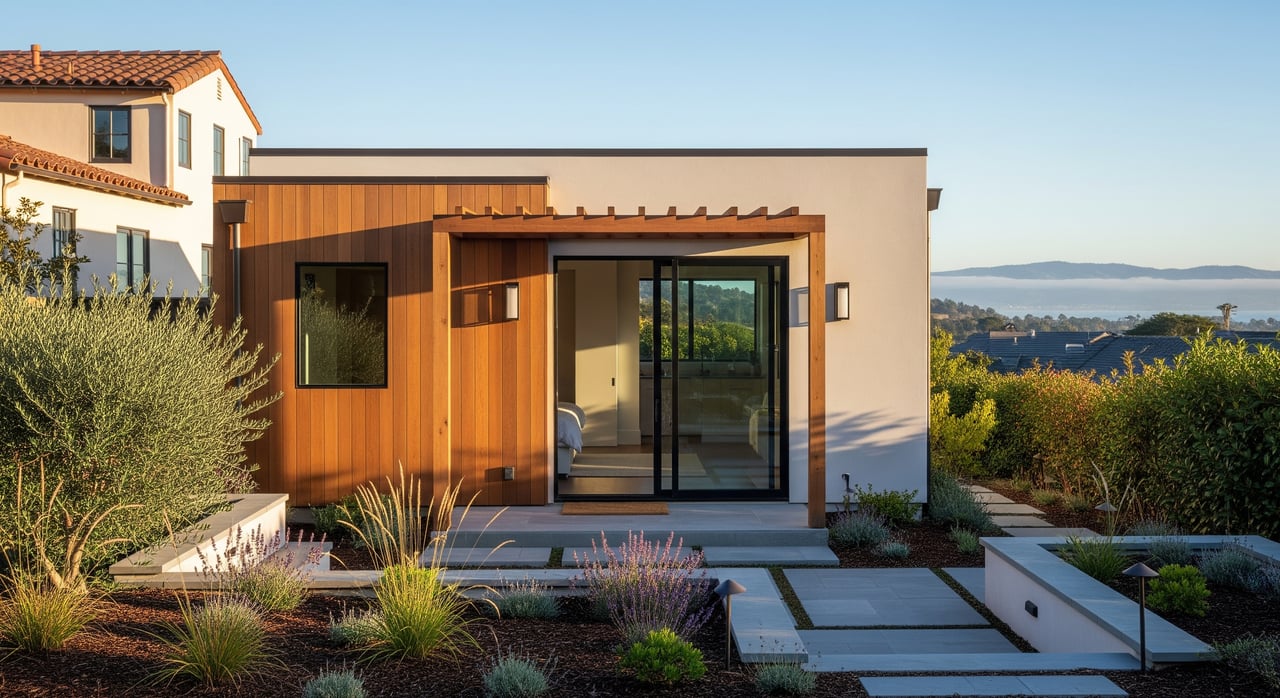
Thinking about turning extra space into steady income or a flexible living setup? In San Rafael and across Marin, many homeowners compare an ADU to a JADU and wonder which route delivers the best mix of approvals, costs, and long-term value. You want clear rules, real numbers, and a roadmap that makes sense for your property and goals. In this guide, you’ll learn the key differences, how local rules affect design and parking, and simple ways to project rents and ROI. Let’s dive in.
ADU vs. JADU basics
An ADU is a self-contained home on the same lot as your primary house. It can be detached, attached, or a conversion of existing space. A JADU is a smaller unit carved out within your existing home, often from a bedroom or interior space, with its own exterior entrance and an efficiency kitchen.
State law sets the baseline rules that San Rafael and Marin must follow. The best summaries are in the California Department of Housing and Community Development’s ADU resources and in California Government Code Section 65852.2. Local ordinances can add specific size, height, and siting standards, so always confirm local numbers before you design.
Quick comparison
| Feature | ADU | JADU |
|---|---|---|
| Location | Detached, attached, or conversion | Inside existing single-family home |
| Typical size | Local limits vary, detached ceilings often up to 1,200 sq ft in many jurisdictions | Up to 500 sq ft by state law |
| Kitchen | Full kitchen | Efficiency kitchen |
| Utilities | Can be shared or separately metered | Often shares utilities with main home |
| Parking | Often 1 space unless exceptions apply; waivers near transit are common | Typically follows ADU parking rules but conversions trigger more exemptions |
| Approval | Ministerial if objective standards are met | Ministerial if standards are met |
Note: San Rafael may allow both a JADU and an ADU on the same single-family lot if you meet local standards. Check with the city to confirm what is allowed on your parcel.
San Rafael rules and permitting
San Rafael provides a ministerial pathway for ADUs and JADUs that meet objective standards. That means no discretionary design hearings in most straightforward cases. Expect a plan set, planning and building review, and inspections. Simple conversions can move faster than ground-up detached units.
For current checklists, plan requirements, and fee schedules, start with the City of San Rafael’s ADU information. A short pre-application conversation can surface deal-breakers early, like height caps, lot coverage, or fire-safety upgrades.
Size, height, and setbacks
State law allows tight rear and side setbacks for many detached ADUs, often as little as 4 feet, subject to fire and safety codes. Local height and floor area rules can be more specific than state guidance. Because numbers change, confirm San Rafael’s current standards before you finalize design.
Parking and transit proximity
San Rafael applies the state parking limits for ADUs. Many properties near transit, including SMART rail and key bus lines, qualify for a parking waiver. If you convert an existing garage or carport, the city cannot require you to replace those off-street parking spaces.
Historic resources and wildfire
If your property sits in a historic overlay or is a listed resource, you may face added review. Marin’s wildfire risk can also trigger requirements like defensible space, sprinklers, or specific materials. These items affect design, timing, and budget, so address them up front.
Fees and impact fees
Under state law, small ADUs under 750 square feet are often exempt from certain impact fees. Larger units may incur prorated impact and sewer connection fees. Check San Rafael’s fee schedule to estimate your range and confirm how fees apply to your unit size.
Marin County unincorporated differences
If your parcel is outside city limits, you will work with the Marin County Community Development Agency. Rural sites can face added constraints such as septic capacity, slope, wildfire zones, riparian setbacks, and access. Start with the county’s ADU resources to confirm zoning and environmental constraints.
Septic capacity is a common limiter in unincorporated Marin. Health department approval may cap your unit size or require system upgrades. Build this into your timeline and budget.
Parking, setbacks, and utilities that affect cost
Parking rules that matter
- No replacement parking is required if you convert a garage or carport to an ADU.
- Near transit, parking can be waived for ADUs. This is common in central San Rafael and near SMART stations and bus corridors.
- In areas without transit access, you may need one off-street space per ADU, unless another state exemption applies.
Setbacks and siting
Detached ADUs often can sit as close as 4 feet from side and rear yards under state rules. Fire, solar access, and site conditions can drive different clearances. On sloped or constrained lots, siting challenges can increase engineering and foundation costs.
Utilities and connection surprises
Water and sewer connections, meter upgrades, and sewer lateral work are frequent cost surprises. Shared metering is common, but separate meters can help with tenant billing. If you are on septic, capacity and system design will shape what you can build and when.
Costs, rents, and ROI in simple terms
Actual costs and rents vary by site and market timing, but a simple framework helps you make decisions. Use local contractor bids for costs and current rental comps within a mile for income estimates. Always add a contingency for unknowns like utility work or fire-safety requirements.
Key cost drivers
- Design and permits, including plans, engineering, and city or county fees
- Construction, including foundation, framing, systems, and finishes
- Site work, including grading, drainage, and utility trenching
- Fire and life safety, including sprinklers and defensible space
- Soft costs, including surveys and utility coordination
- Financing costs and interest carry
- Furnishings and appliances if you plan to rent furnished
Typical Bay Area ranges
- Garage or interior conversions often land from the tens of thousands into the low hundreds of thousands, depending on scope and condition.
- Detached, ground-up ADUs commonly range from the mid-hundreds of thousands to 400 to 600 thousand dollars or more, especially with Marin wildfire and site requirements.
Use these as broad ranges only. Always confirm with 2 to 3 local bids.
Estimating rent
Pull comparable rentals within 0.5 to 1.0 mile that match size and condition. Studio and one-bedroom comps are most relevant for many ADUs and JADUs. Consider proximity to downtown San Rafael, transit, and commute corridors, along with amenities like outdoor space and parking.
ROI metrics to know
- Cap rate proxy: Net operating income divided by total project cost.
- Cash-on-cash return: Annual cash flow after debt service divided by your cash invested.
- Simple payback: Total project cost divided by annual net cash flow.
Account for vacancy, management, maintenance, insurance, taxes, utilities, and reserves. Financing will change results, so model both cash and loan scenarios.
Hypothetical examples
These examples are illustrative. Use current bids and rent comps to build your own model.
- Scenario A, garage conversion as JADU or ADU: Build cost 80,000 dollars, rent 2,200 dollars monthly, vacancy 6 percent, operating expenses 3,000 dollars yearly. Annual gross rent is 26,400 dollars. Net operating income is about 21,816 dollars. Simple payback is roughly 3.7 years.
- Scenario B, detached ADU: Build cost 350,000 dollars, rent 3,200 dollars monthly, vacancy 6 percent, operating expenses 4,500 dollars yearly. Annual gross rent is 38,400 dollars. Net operating income is about 31,596 dollars. Simple payback is roughly 11.1 years.
Smaller conversions often deliver faster payback, while detached units can boost long-term property value and flexibility.
Financing and incentives
Common options include HELOCs, cash-out refinancing, construction loans, and renovation loans. Periodic local incentives or preapproved plan programs may appear, so check San Rafael and Marin County planning pages for current offerings. Ask your lender and appraiser how a legal ADU could affect valuation in your neighborhood.
Which is better: ADU or JADU?
Choose a JADU if you want a lower-cost, faster path that stays within your existing footprint. JADUs are ideal for creating rental income or a private suite with minimal site work. Choose an ADU if you want maximum flexibility, privacy, and long-term value, including potential multi-generational living.
Many single-family lots can support both a JADU inside the home and a detached or attached ADU in the yard, subject to local standards. Owner-occupancy rules have been limited by state law in recent years, but local policies can differ between ADUs and JADUs. Confirm current requirements with the city or county before you plan to rent.
Step-by-step checklist
- Confirm your parcel’s jurisdiction and zoning with the City of San Rafael or Marin County.
- Schedule a pre-application meeting to review size, height, setbacks, parking, and any wildfire or historic constraints.
- Check utilities early, including sewer or septic, water meter capacity, and any needed laterals or upgrades.
- Clarify fire and life safety requirements, including defensible space and sprinklers.
- Pull rental comps within 0.5 to 1.0 mile to estimate achievable rent.
- Get 2 to 3 local contractor bids that include utility trenching, connections, and contingency.
- Run ROI scenarios: cap rate proxy, cash-on-cash, and simple payback, with and without financing.
- Decide on metering, tenant billing, and how you will handle utilities.
- Review overlays, HOA rules, and any CC&Rs that could affect design.
- Plan for property management and set monthly reserves for maintenance.
Bottom line
You have two strong paths to add value in San Rafael. A JADU makes use of what you already have, often with quicker approvals and lower cost. An ADU delivers a stand-alone space that can command higher rent and add more flexibility. The right answer depends on your lot, budget, and timeline.
If you want a grounded plan for your property, including rent comps, likely timelines, and a realistic budget, reach out for local guidance. You will get clear next steps and a practical path from idea to final inspection. Contact Oliver Burgelman for a no-pressure conversation about your goals.
FAQs
What is the difference between an ADU and a JADU in San Rafael?
- An ADU is a self-contained unit that can be detached, attached, or a conversion, while a JADU is up to 500 square feet within the existing home with an efficiency kitchen.
Are parking spaces required for ADUs in San Rafael near transit?
- Often no; if your ADU is near transit or is a conversion, state rules can waive parking requirements, but confirm with the City of San Rafael.
Do I need to replace garage parking if I convert it to an ADU?
- No; state law does not allow cities to require replacement off-street parking for garage or carport conversions.
Can I build both a JADU and an ADU on one single-family lot?
- In many cases yes, subject to local standards; verify your parcel’s eligibility with San Rafael planning staff.
How long do ADU permits and construction take in San Rafael?
- Simple conversions can move in weeks, while detached builds with utility work can take several months from plan submittal to final inspection.
Are ADUs under 750 square feet exempt from some impact fees?
- Yes, state law often exempts smaller ADUs from certain impact fees, while larger units may pay prorated fees; check the current city fee schedule.
Where can I find official ADU rules and checklists for San Rafael and Marin County?
- Review the City of San Rafael’s ADU information and Marin County’s ADU resources, along with state guidance from HCD.